
Professional Boat Removal Services in Charleston, WV

An old boat resting on a trailer behind a garage in Charleston, WV can quietly deteriorate for six seasons until the tires flatten deep into the dirt. A marina manager sends a formal notice regarding unpaid slip fees, or a residential property sells with a neglected cabin cruiser still sitting in the driveway. Sometimes an outboard motor seizes completely, and the total cost of a rebuild far exceeds the actual market value of the vessel. In each situation, the hull remains stationary while space is consumed and property management issues escalate, leaving the owner with a heavy burden that requires a real plan for junk boat disposal.

Is there boat removal near me in Charleston, WV? Boat Removal Experts provides professional boat removal services directly to your location, handling the heavy lifting and transportation required to clear your property efficiently.

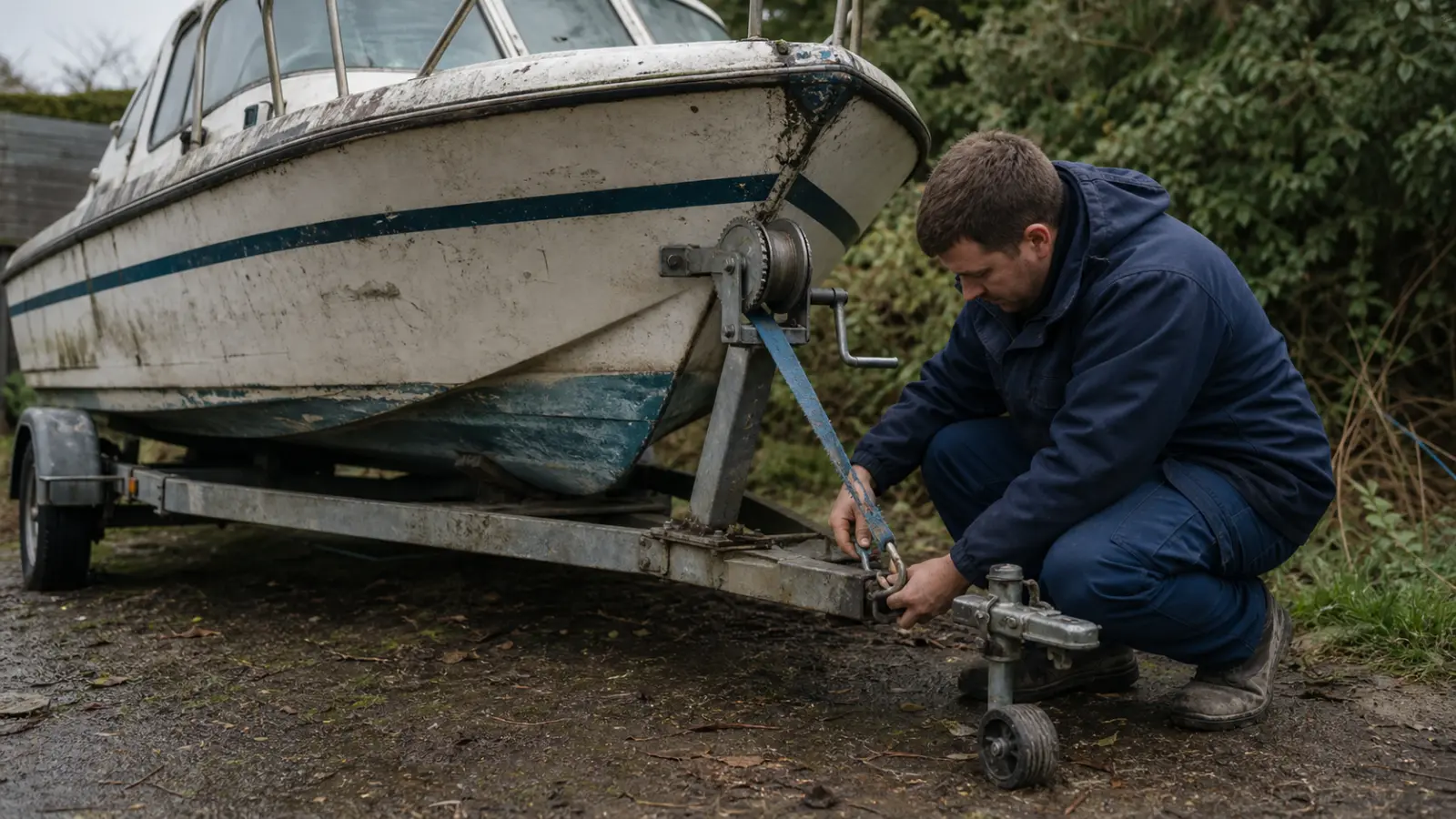
Worker checking the trailer winch before hauling an old boat

Before any vessel leaves the property, addressing ownership records is critical. Our process ensures we issue a formal release of liability to the owner upon taking possession. While we do not always transfer the title into our company name, this signed release protects you from future claims or municipal fines. Some haulers haul away an old boat without providing formal paperwork, which leaves the original owner legally exposed if the hull is dumped unlawfully. Requesting proper documentation before work begins prevents long-term liability risks.

Transporting a vessel presents unique physical challenges that go beyond simple towing. A rusted trailer might have seized hubs or rotting frame rails that cannot handle highway speeds. Keels and custom storage cradles require specialized flatbed rigging, while wide beams often exceed narrow access gates. Furthermore, pulling immense weight across soft lawn soil without rutting the yard requires specialized recovery equipment.

Call 304-249-9334 to start.

Send photos through the contact form.

What Is Boat Removal and When You Need It

Professional boat removal covers far more than simply hitching a trailer to a truck and driving away. When a vessel is structurally compromized or lacks structural integrity, crews must evaluate the safest method to extract it from the premises. An abandoned boat left on private property or a derelict vessel remaining in a commercial slip requires careful planning to prevent environmental contamination and physical damage to surrounding structures. The scope of service adapts to whether the vessel rests on dry land, sits on decaying blocks, or remains tied up in the water.
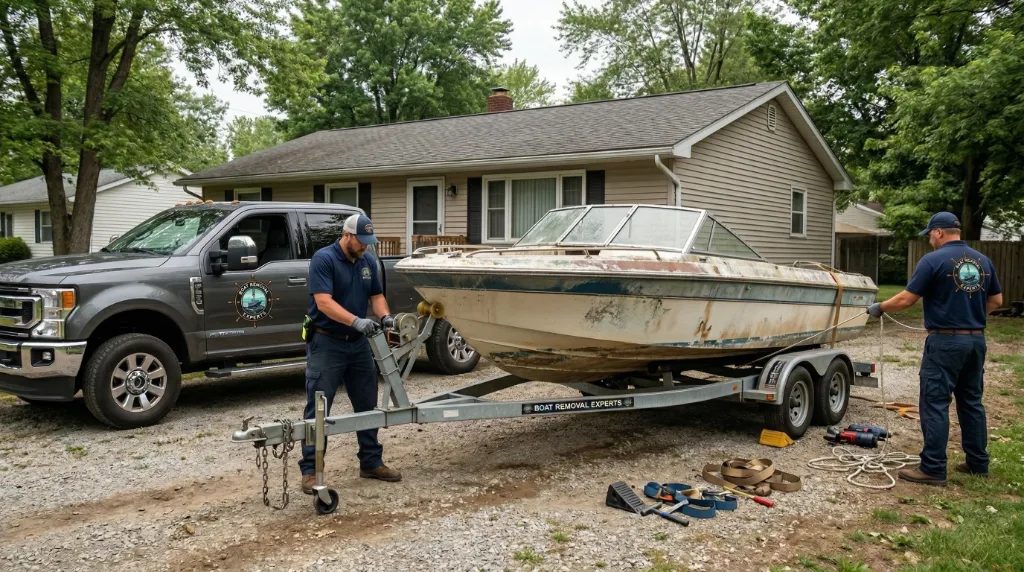
Crew securing an old boat on a trailer for removal

Paperwork status directly influences how an abandoned boat removal project is executed. Having a clear title in hand simplifies the process, allowing for immediate scheduling and straightforward processing. When documentation is missing, lost, or acquired alongside a recent real estate purchase, alternative legal steps must be completed before transport. Municipal guidelines and property laws dictate how a derelict vessel must be noticed and processed before it can be legally cleared from the land or dock.

The physical location of the hull also determines the logistics involved in boat disposal. Vessels left on non-paying slip spaces often face tight access constraints between neighboring slips, requiring precise maneuvering to extract without impacting adjacent watercraft. When a vessel has been left stranded on open land or behind outbuildings in Kanawha County, surrounding terrain, overhead branches, and soil stability dictate whether the unit can be rolled out intact or must be handled using specialized loading apparatus.
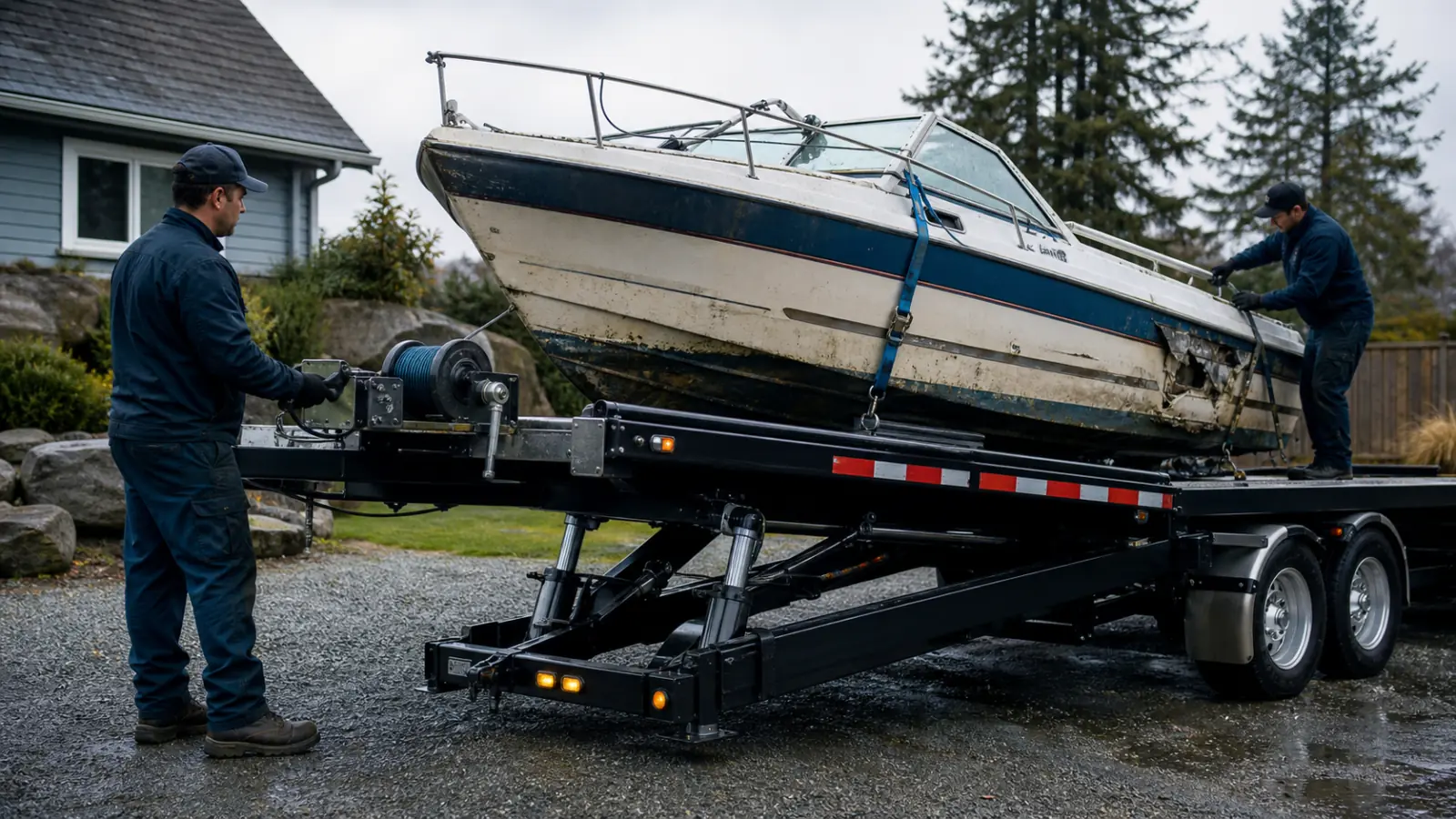
Crew winching an old boat onto a flatbed trailer

When Charleston Residents Call Us

In Charleston, WV, extreme seasonal temperature swings and persistent precipitation severely accelerate the decline of an unused vessel. Rainwater pooling inside an open deck eventually seeps into floorboards, causing severe core rot and structural failure. Freezing winter temperatures expand trapped moisture, cracking fiberglass gelcoat and fracturing engine blocks that were never properly winterized. Humidity promotes mildew throughout upholstery and rots wooden floor frames, turning a once-sturdy fishing boat, spacious pontoon, or heavy sailboat into a fragile liability that poses structural risks during transport.
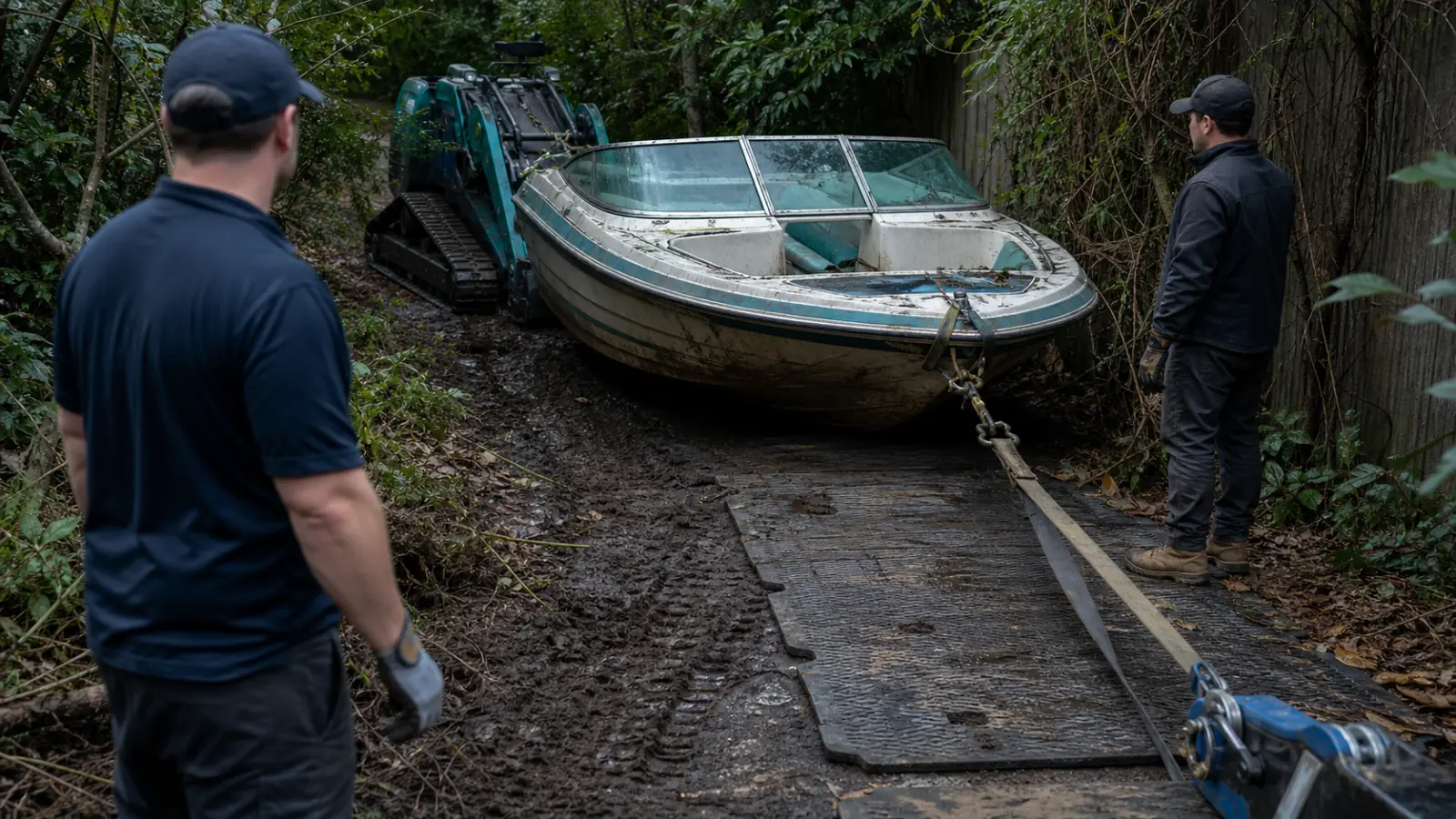
Crew recovering a boat from an overgrown yard using ground mats

Local terrain and property layouts present distinct challenges during the extraction process. Properties near South Charleston, Malden, and Dunbar often feature steep driveways, narrow access lanes, and soft ground that complicates heavy vehicle positioning. When a vessel rests in Rand or Coal Fork, crews must account for tight turn radiuses, low-hanging overhead utility lines, and narrow gates that restrict standard haulers. Crossing wet turf without sinking requires specialized mats or winch systems to pull the load safely to pavement.

The physical mounting of the vessel heavily influences the setup required for recovery. A pontoon sitting on a solid dual-axle trailer presents different clearance requirements than a keel-heavy sailboat rested on wooden blocks or a deeply bogged fishing boat buried in mud. Crews assess site lines, ground slope, and structural integrity before attaching winches, ensuring the vessel is moved without disrupting surrounding structures or creating safety hazards on the driveway.
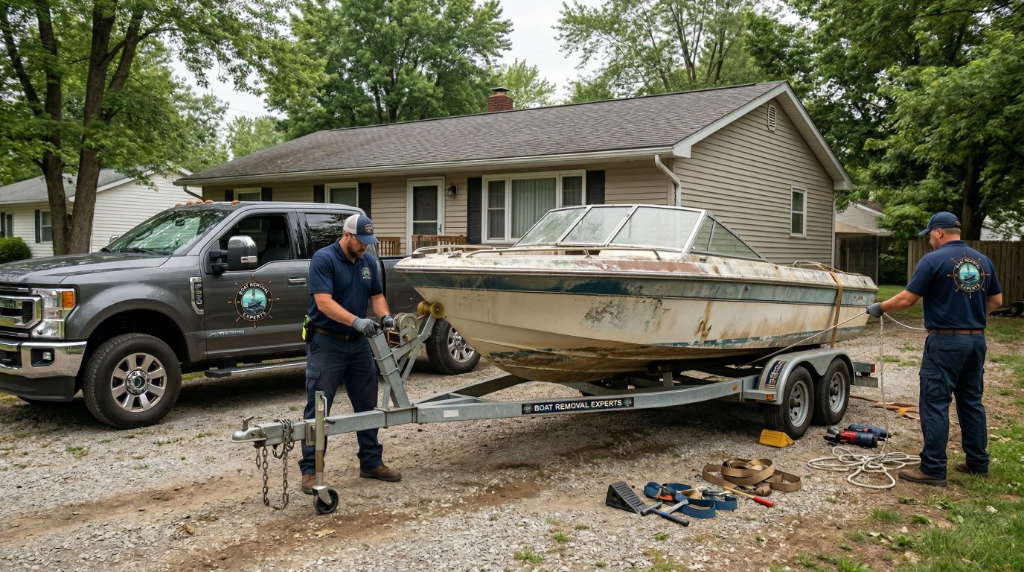
Crew securing an old boat on a trailer for removal

Every Type of Boat We Handle

Situations We Handle

Need Help? We’re Ready.

Contact boat removers directly or request free quotes. We dispatch crews fast.

Our Step-by-Step Process

Assessment

We evaluate the boat’s size, current location, condition, and any environmental or access challenges before we schedule boat removal.

Planning

A detailed plan is built around your vessel — equipment, logistics, timeline, and safety. Services include drainage of oil and fuel before transport.

Execution

Our experienced crew mobilizes to your current location and we tow, haul, or dismantle the vessel using professional marine equipment.

Completion

The vessel is recovered, recycled, or routed to certified boat junkyards for environmentally responsible disposal. The site is left clean.

Equipment & Capabilities

When a vessel cannot roll on its own tires, specialized recovery equipment is deployed to complete the extraction. Winches, heavy-duty hydraulic jacks, and temporary transport dollies are used to lift and stabilize a sunken or off-trailer hull. If structural decay, extreme beam width, or limited property access prevents hauling the vessel intact, the crew will dismantle the superstructures directly on site. Cutting the hull into manageable sections allows for safe removal from tight backyard spaces without destroying surrounding landscaping.

Before any hull is winched onto a flatbed or dismantled, all hazardous materials are systematically identified and removed. Fuel tanks are drained, crankcase oil is safely extracted, and marine batteries are disconnected to prevent acid spills or fire hazards. Electronic components, pyrotechnic flares, and pressurized fire extinguishers are removed for proper processing. Disposing of these substances in accordance with local environmental standards prevents ground contamination during handling and transport.

Where the materials end up depends entirely on the condition of the vessel upon inspection. Once the crew evaluates the hull composition, sound metal components like aluminum hulls or stainless steel hardware may be directed toward metal recycling facilities. Fiberglass sections, rotted wood cores, and degraded interior materials that cannot be reclaimed are processed for proper landfill containment. Each step of the operation is determined by access constraints, structural safety, and material composition discovered at the job site.

Our boat removal experience covers everything from start to finish  assessment, planning, execution, dismantling, and final cleanup. Marina operators and property owners across Kanawha County trust us to get rid of your junk boat without damage to surrounding property.

FAQ

Boat Removal Questions - Frequently Asked

Common questions from property owners about our junk removal service, dismantling, and marine recovery.

We handle every type of vessel — sailboat, pontoon, fishing boats, jon boats, yachts, and commercial craft. Whether your boat or sailboat floats (or used to), we’ll remove it from any current location.

Yes. Sunken and partially submerged vessel recovery is a core part of our salvage work in Kanawha County. We use lift bags, salvage pumps, and marine cranes to safely raise vessels from underwater.

We respond to inquiries quickly — usually within hours, with same-day service available. For emergency situations, we mobilize as fast as possible. Call us directly for time-sensitive jobs.

No. Every job is handled in-house by our own team and equipment. No middlemen, no handoffs, no surprises.

Cost depends on the boat’s size, current location, condition, and complexity of the job. We provide free assessments and free quotes for every case — contact us and we’ll give you an honest estimate.

Yes. Our boat removal and disposal services include hazardous materials handling, oil and fuel drainage, hull dismantling, and recycling at certified yards — all in compliance with environmental regulations and environmentally responsible standards.

Absolutely. We regularly work in tight marinas, shallow waterways, private docks, backyards, and remote areas. We bring the right gear to reach any current location.

Yes. We frequently work with insurance adjusters on salvage and recovery claims and provide the documentation needed for your claim.

Browse Our Services - Ready to Get Started?

We handle everything from start to finish. Call us now or request a free quote – we’ll dispatch crews and haul your vessel away fast.