
Professional Boat Removal Services in Chicago, IL

The fiberglass hull has sat on a trailer behind the garage for six seasons, surrounded by weeds while the tires have flattened into the dirt. A marina sent a certified notice about an unpaid slip fee that keeps accruing, or perhaps a property recently sold with an old cabin cruiser still resting on the lot. In other cases, the outboard motor seized years ago and a complete rebuild costs far more than the vessel is worth. Leaving a junk boat to collect rainwater in Chicago, IL only worsens the structural damage and creates an eyesore on the property.

Is there boat removal near me in Chicago, IL? Yes, Boat Removal Experts manages the extraction, transport, and complete handling of unwanted vessels directly from residential yards, commercial lots, or local slips.

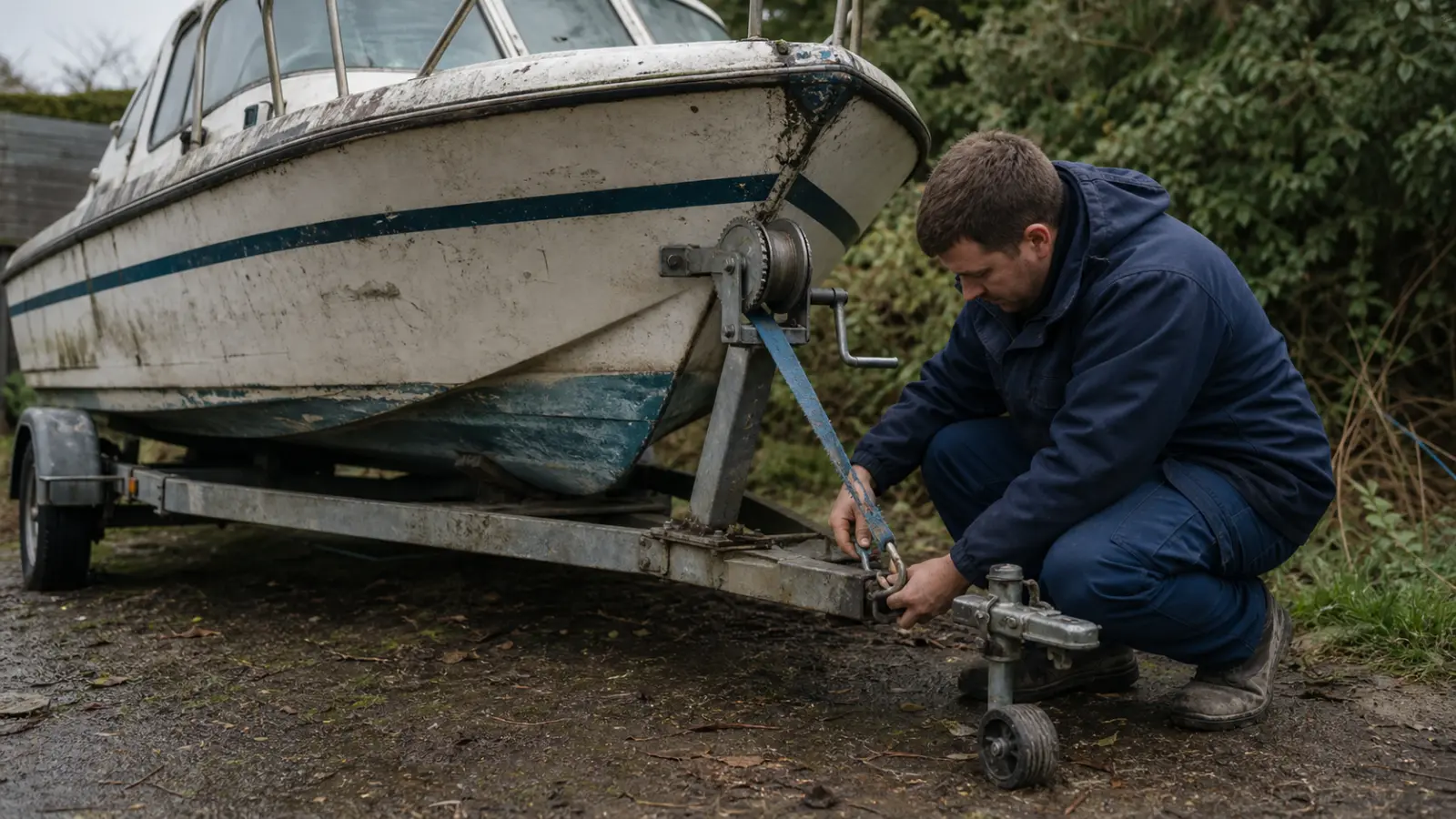
Worker checking the trailer winch before hauling an old boat

When clearing a vessel, liability release is a critical step for the legal owner. While we do not always transfer the title of every craft, we always issue an official release of liability to document that the vessel has left your possession. Certain unverified operators haul a hull away without executing any formal legal paperwork, leaving the original owner fully vulnerable to future fines or abandonment citations. Asking for official liability documentation before any work begins protects your financial standing.

Moving a vessel is significantly harder than transporting a standard vehicle. A rotted trailer may suffer structural axle failure the moment it moves, or a heavy deep-V hull might sit in a customized cradle that cannot roll. Tight alleyways, narrow side gates, and soft soil surfaces mean heavy equipment can sink or become trapped before reaching a hard paved street.

Call 847-961-2354 to start.

Send photos through the contact form.

What Is Boat Removal and When You Need It

Professional boat disposal goes far beyond simply hitching a frame to a truck and driving away. A complete service requires evaluating the physical state of the vessel, selecting specialized transport gear, and managing all associated compliance. When a derelict craft sits behind a building or in a storage yard, the process involves securing loose structures, addressing trapped water, and choosing an appropriate method to haul the unit safely without damaging surrounding real estate.

Paperwork dictates how an abandoned boat or private craft moves through the system. Having a clean title in hand allows for a quick processing path. However, when legal documents are missing, destroyed, or tied to a property acquisition where a previous owner left an old boat behind, distinct administrative steps must occur. The presence of a valid HIN, active lien records, or clear municipal registry files impacts how the legal disposal moves forward.
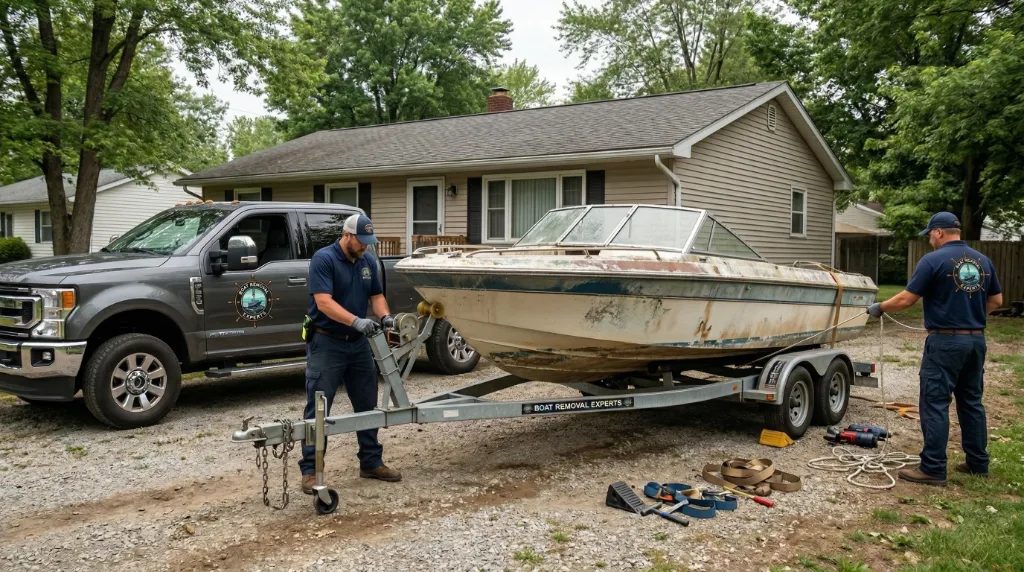
Crew securing an old boat on a trailer for removal

When an abandoned boat sits on private property without permission or remains tied up in a commercial slip without active payment, specific legal notifications take effect before physical transport happens. Landowners and facility operators must ensure the correct legal claim exists before moving a vessel off the site. The structural integrity of the back panel, the presence of heavy inboard machinery, and overall hull width determine whether a recovery unit hauls the craft whole or prepares it for site extraction.
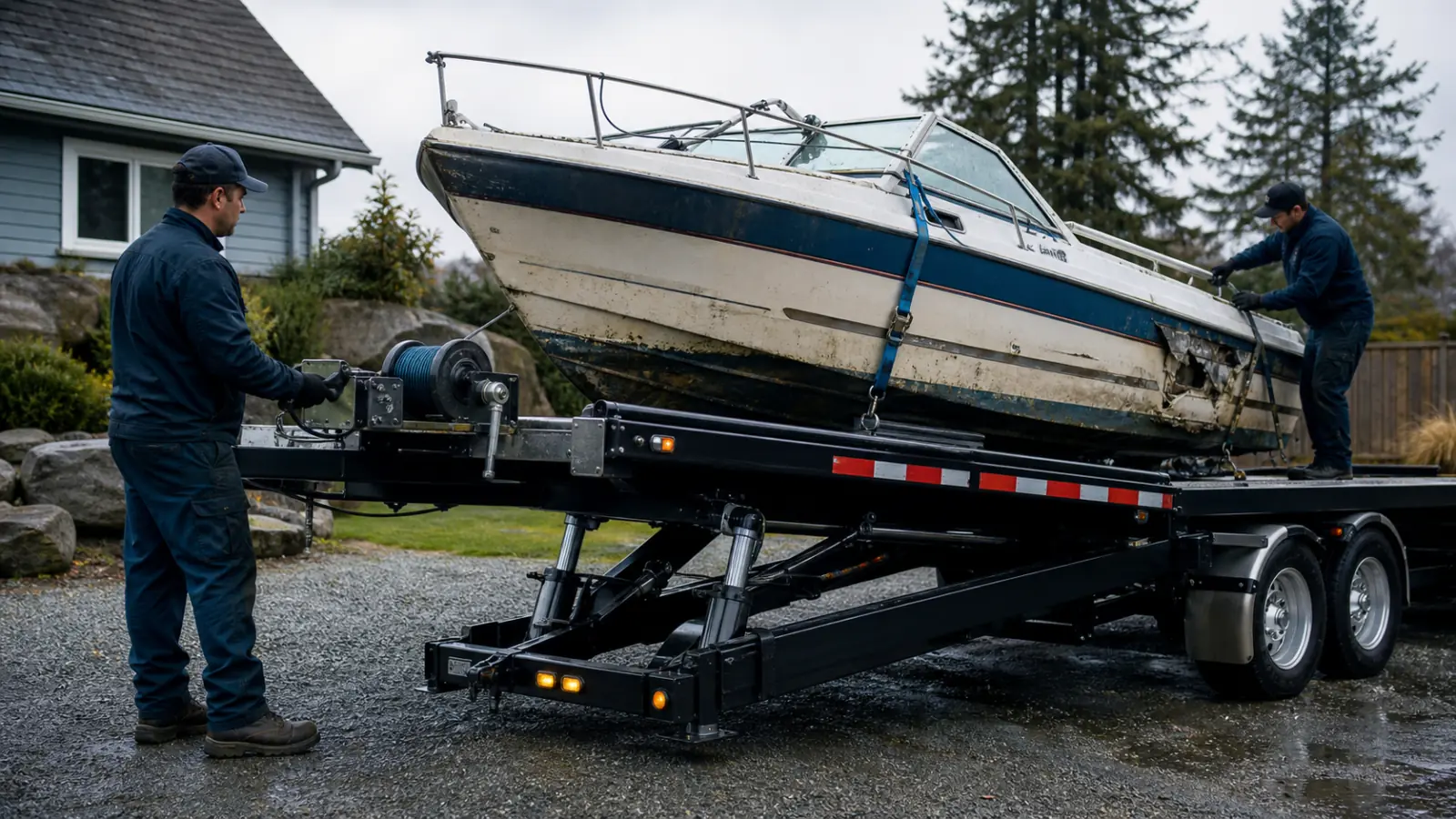
Crew winching an old boat onto a flatbed trailer

When Chicago Residents Call Us

Harsh seasonal climate in Chicago, IL takes a heavy toll on watercraft left outdoors year-round. Freeze and thaw cycles drive moisture deep into microscopic cracks in the gelcoat, causing the fiberglass layers to delaminate over time. Snow loads crush soft tops and cabin roofs, while standing rainwater saturates internal wood floor frames, deck plywood, and foam core materials. Waterlogged upholstery molders rapidly, and a hull filled with trapped ice becomes thousands of pounds heavier than its original dry manufacturing weight, complicating any future lifting operations.
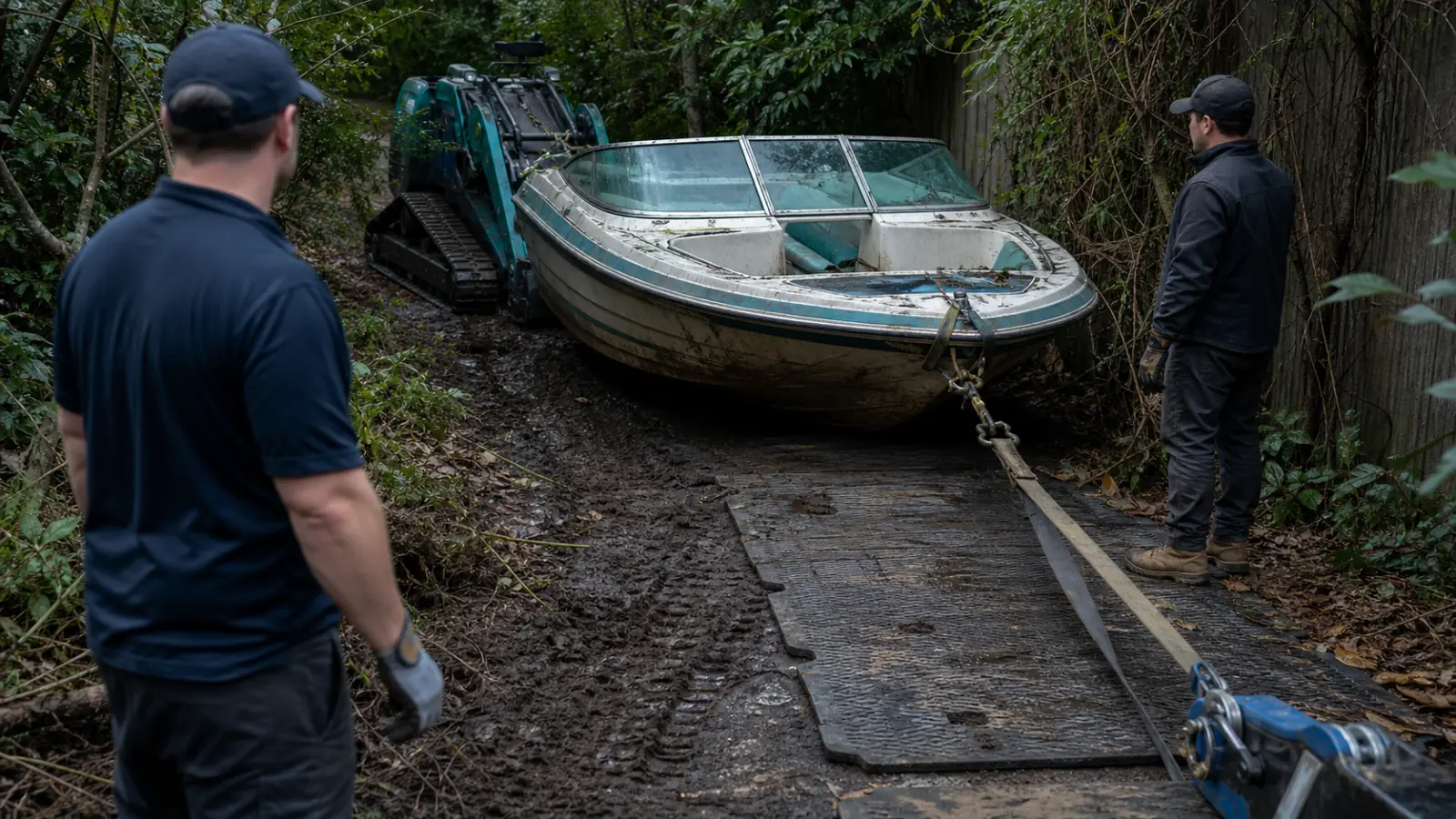
Crew recovering a boat from an overgrown yard using ground mats

Property owners call for help with everything from a neglected pontoon taking up driveway space to a heavy fishing boat or a deep-keel sailboat resting on rotting wooden blocks. Nearby areas like Cicero, Stickney, Forest View, Berwyn, and Oak Park feature tight residential access where maneuverability is limited. The specific path from the resting spot to the public street dictates the recovery strategy.

Site access factors heavily into the plan. A crew must evaluate whether a transport rig has a solid surface to drive on, or if a heavy truck would sink into soft ground. Overhead lines, low tree branches, narrow residential gates, and close adjacent structures often block standard towing equipment. Whether the craft sits on a flat trailer, rests in a timber cradle, or floats in a marina slip, the immediate physical layout dictates how the team extracts the craft safely without damaging nearby property.
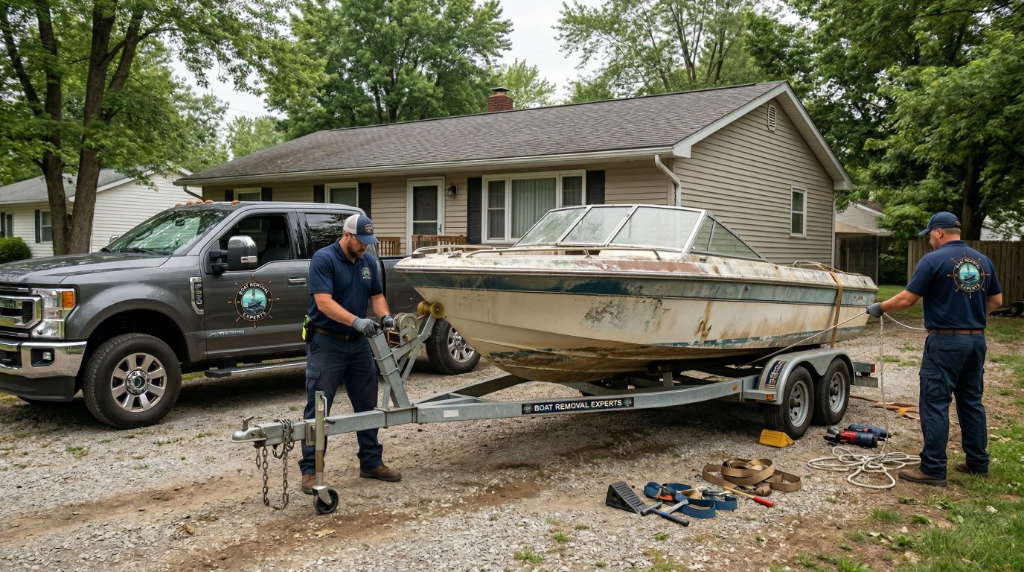
Crew securing an old boat on a trailer for removal

Every Type of Boat We Handle

Situations We Handle

Need Help? We’re Ready.

Contact boat removers directly or request free quotes. We dispatch crews fast.

Our Step-by-Step Process

Assessment

We evaluate the boat’s size, current location, condition, and any environmental or access challenges before we schedule boat removal.

Planning

A detailed plan is built around your vessel — equipment, logistics, timeline, and safety. Services include drainage of oil and fuel before transport.

Execution

Our experienced crew mobilizes to your current location and we tow, haul, or dismantle the vessel using professional marine equipment.

Completion

The vessel is recovered, recycled, or routed to certified boat junkyards for environmentally responsible disposal. The site is left clean.

Equipment & Capabilities

Extracting a vessel whose trailer has completely rusted out requires heavy rigging equipment. Crews utilize specialized hydraulic drop-deck trailers, mobile cranes, sliding winches, and temporary support bunks to hoist a vessel off the ground when its tires are rotted or axles are snapped. If a hull is too wide for tight alleyways or too structurally compromized to haul safely in one piece, workers dismantle the structure directly on site using heavy cutting tools and reciprocating saws.

Before any physical cutting or highway transport occurs, all hazardous materials must be safely identified and removed. Technicians drain fuel tanks, extract engine oil, flush hydraulic steering lines, and remove lead-acid batteries alongside old electronic navigational displays to prevent environmental contamination. These fluids and toxic elements are separated into proper containment units for safe chemical handling according to municipal regulations.

Once the hazardous components are cleared and the vessel is rendered inert, the remaining materials are processed. Solid fiberglass, aluminum framing, internal lead ballast, and scrap iron are sorted based on their material composition. Sound metal structures move toward material recycling streams, while unrecoverable composite materials travel to designated industrial processing facilities. The final disposition depends entirely on the structural condition and material breakdown assessed by the crew when they evaluate the vessel on site.

Our boat removal experience covers everything from start to finish  assessment, planning, execution, dismantling, and final cleanup. Marina operators and property owners across Cook County trust us to get rid of your junk boat without damage to surrounding property.

FAQ

Boat Removal Questions - Frequently Asked

Common questions from property owners about our junk removal service, dismantling, and marine recovery.

We handle every type of vessel — sailboat, pontoon, fishing boats, jon boats, yachts, and commercial craft. Whether your boat or sailboat floats (or used to), we’ll remove it from any current location.

Yes. Sunken and partially submerged vessel recovery is a core part of our salvage work in Cook County. We use lift bags, salvage pumps, and marine cranes to safely raise vessels from underwater.

We respond to inquiries quickly — usually within hours, with same-day service available. For emergency situations, we mobilize as fast as possible. Call us directly for time-sensitive jobs.

No. Every job is handled in-house by our own team and equipment. No middlemen, no handoffs, no surprises.

Cost depends on the boat’s size, current location, condition, and complexity of the job. We provide free assessments and free quotes for every case — contact us and we’ll give you an honest estimate.

Yes. Our boat removal and disposal services include hazardous materials handling, oil and fuel drainage, hull dismantling, and recycling at certified yards — all in compliance with environmental regulations and environmentally responsible standards.

Absolutely. We regularly work in tight marinas, shallow waterways, private docks, backyards, and remote areas. We bring the right gear to reach any current location.

Yes. We frequently work with insurance adjusters on salvage and recovery claims and provide the documentation needed for your claim.

Browse Our Services - Ready to Get Started?

We handle everything from start to finish. Call us now or request a free quote – we’ll dispatch crews and haul your vessel away fast.