
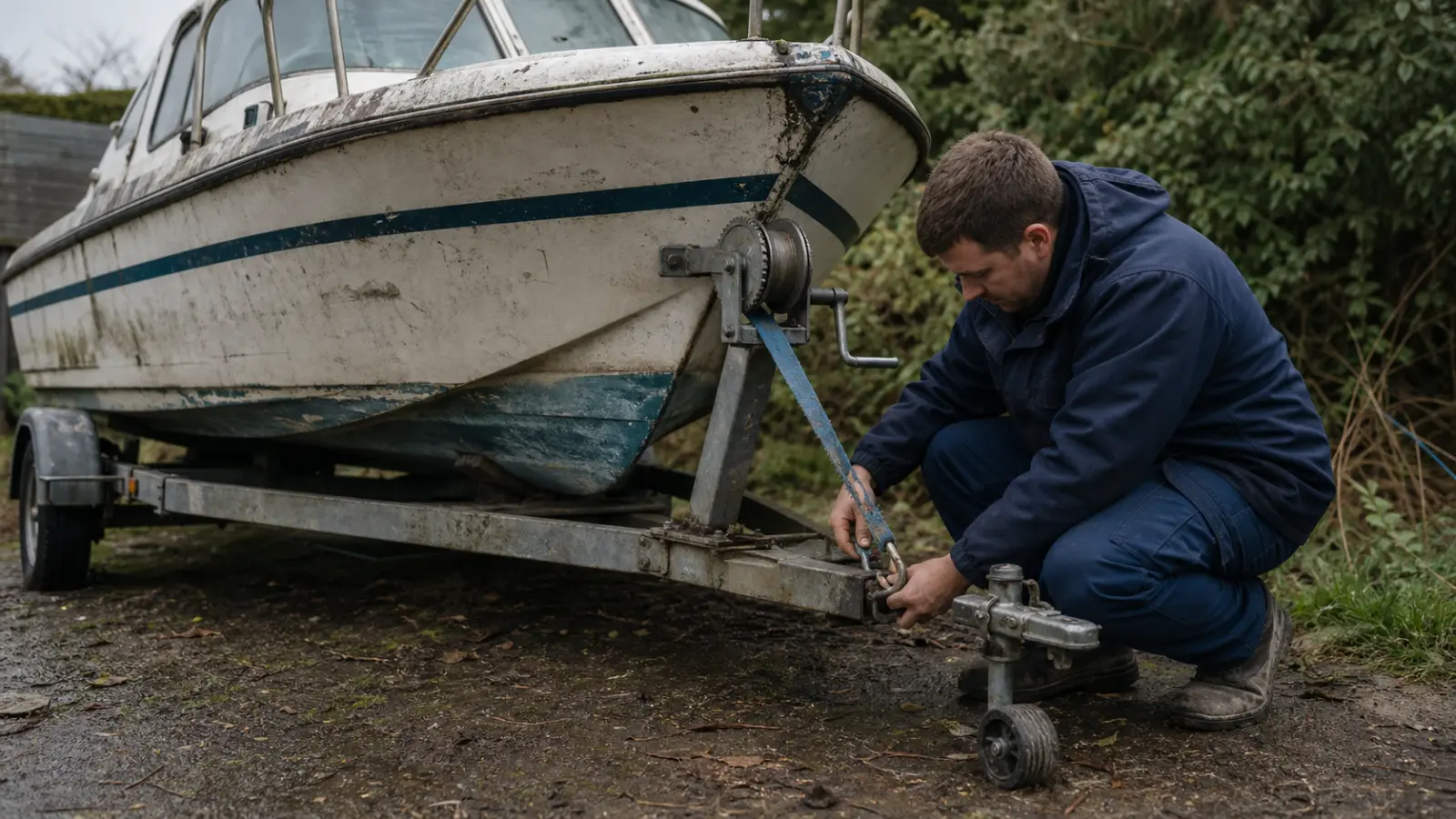
Professional Boat Removal Services in Westford, MA

That old boat sitting on a flat-tired trailer behind your garage has probably missed six consecutive seasons. The tires have rotted directly into the soil, the canvas cover disintegrated two winters ago, and a tree branch now hangs low over the back panel. Alternatively, you might be staring at an abandoned vessel left on a lot you just purchased, or perhaps a local marina sent a final notice regarding an unpaid slip where the outboard motor seized years ago and the cost of a rebuild far exceeds the market value of the vessel. In every case, what was once a source of weekend recreation has quietly transformed into a permanent fixture taking up valuable space on your property.

Is there boat removal near me in Westford, MA? Boat Removal Experts provides complete hauling and site clearing for derelict vessels, broken trailers, and abandoned watercraft throughout the entire municipality of Westford, MA.

When our crew extracts a junk boat, paperwork matters just as much as heavy equipment. We do not always transfer the vessel title, but we always issue a formal release of liability to the owner. Some haulers will simply hook up a rig and pull a craft away without any documentation, leaving the original owner fully responsible if the hull is later dropped, abandoned elsewhere, or fined by local authorities. Asking for proper written release protects you long after the vehicle drives away.

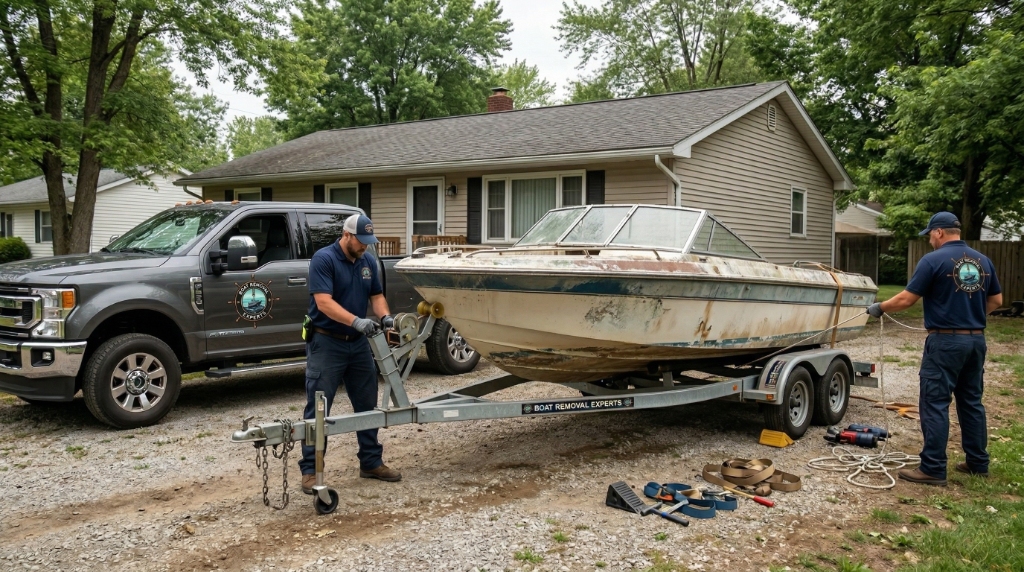
Getting a vessel off a residential lot is rarely as simple as backing up a truck. A trailer with frozen hubs will not roll, narrow side gates block access, keels sink into soft grass, and wide beams clear overhead branches by mere inches. The weight of a watercraft sitting directly on the turf can easily immobilize standard towing rigs that lack specialized winches.

Call 978-404-5860 to start.

Send photos through the contact form.

What Is Boat Removal and When You Need It

Professional boat disposal extends far beyond merely hooking a line to an old boat and pulling it down the road. Comprehensive junk boat handling requires evaluating the structural integrity of the hull, securing loose deck components, managing heavy keels, and transporting the vessel safely without causing damage to surrounding structures or surfaces. When an abandoned boat sits on private land, the process begins with identifying who holds authority over the physical space and determining how the hull can be safely moved without creating additional hazards for the property owner.
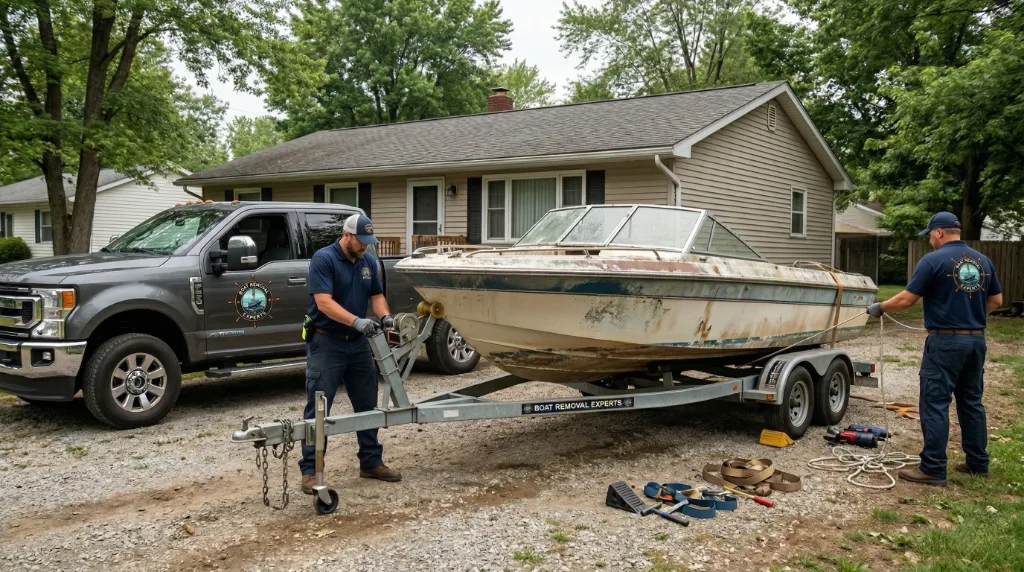
The status of the paperwork strongly influences how the removal progresses. Having a clean title in hand simplifies the initial steps, but owners frequently face situations where documents were lost decades ago, or an abandoned boat came along with a newly purchased parcel of land. When a vessel rests on someone else's property or occupies a slip that is no longer paid for, clear legal authorization must be established before any crew sets foot on the site. What changes between these scenarios is the specific verification needed prior to load winching and transit.

Physical condition also dictates how get rid of a boat efforts are executed. A hull that has structural compromise or holds thousands of pounds of trapped water requires entirely different handling than a dry fiberglass shell resting intact on a functional cradled trailer. The presence of steering hardware, rusted mounting brackets, or rotted deck planking affects the balance and points of leverage used during loading, shifting the job from a simple load-and-go task to a detailed recovery operation.
When Westford Residents Call Us

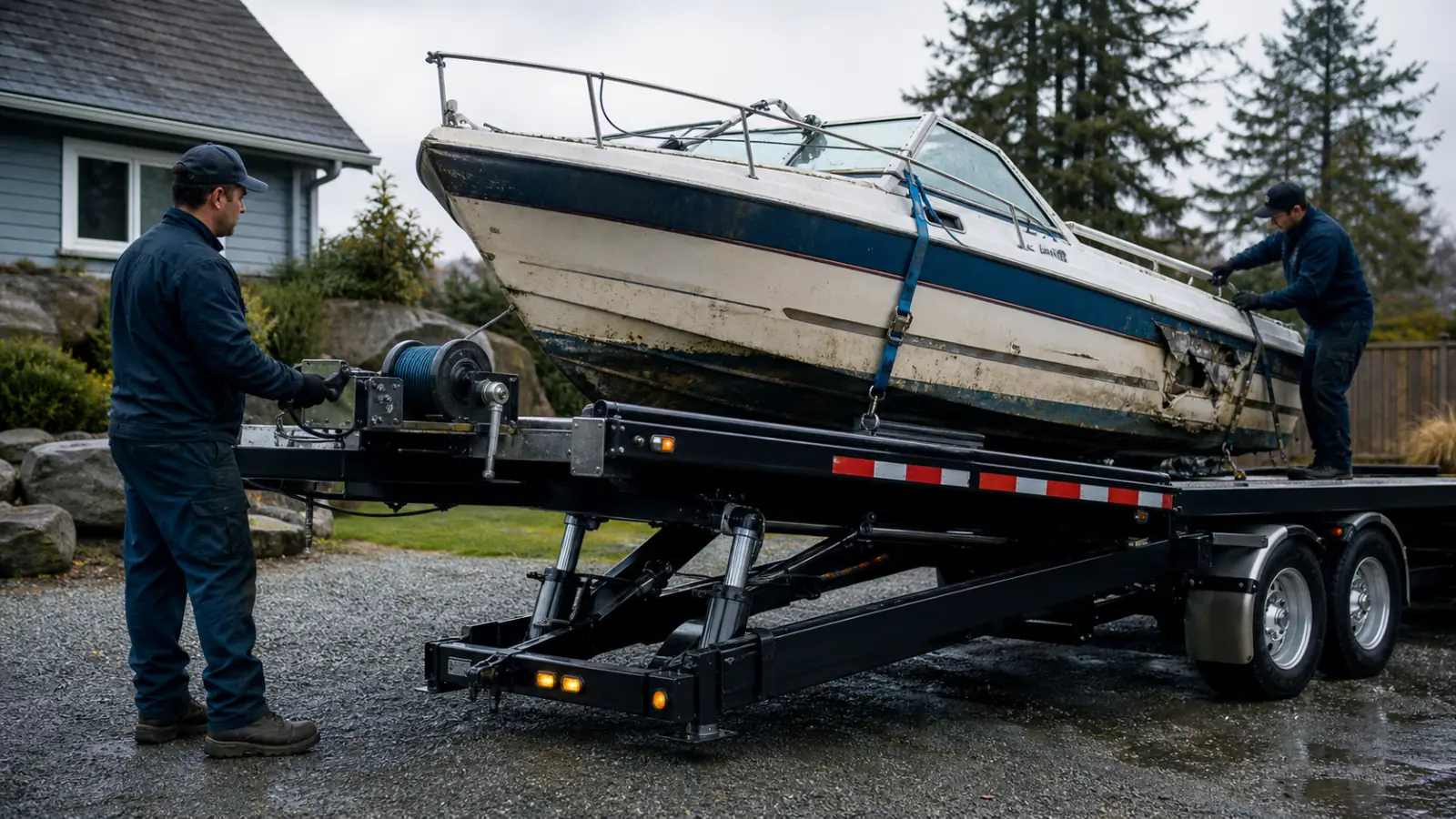
Rigorous New England weather patterns take a heavy toll on watercraft left outdoors without climate-controlled storage. In Westford, MA, constant freeze-and-thaw cycles break down exterior gelcoat, allowing water to seep into sub-floor wood and fiberglass floor frames. Rainwater collects inside open cockpits, freezing during winter months to expand hull seams, rot internal back panel supports, and ruin vinyl upholstery. Over time, a neglected sailboat, fishing boat, or pontoon becomes immensely heavy as internal core materials soak up moisture like a sponge, weakening structural lifting points and complicating the recovery process.
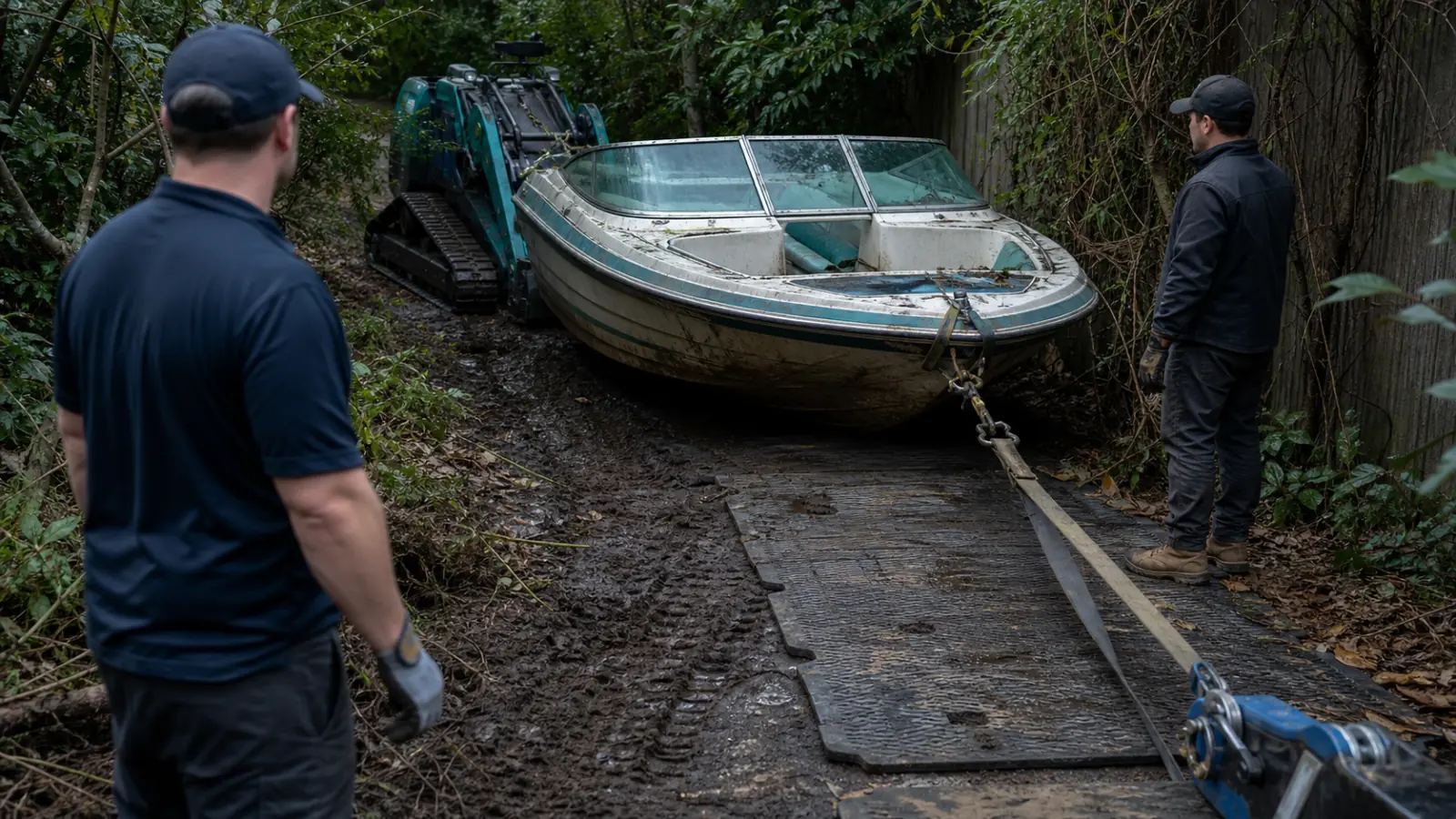
Local property layouts in Westford, MA present distinct challenges for heavy transit equipment. Narrow residential driveways, overhanging tree canopy lines, soft earth near lawns, and decorative stone walls all dictate how close a hauling vehicle can get to the work site. Access paths must be carefully measured to ensure that heavy machinery does not sink into saturated ground or snag overhead power lines during operations.

The physical posture of the watercraft further alters the work strategy. A fishing boat resting on blocks requires specialized hydraulic jacks or crane straps to lift cleanly, while a pontoon sitting on a buried trailer demands winching equipment capable of pulling dead weight out of deep mud. A sailboat with its rig intact requires careful dismantling of standing rigging before it can clear street clearance limits, while vessels in the water must be maneuvered to access points capable of supporting heavy transport loads.
Every Type of Boat We Handle

Situations We Handle

Need Help? We’re Ready.

Contact boat removers directly or request free quotes. We dispatch crews fast.

Our Step-by-Step Process

Assessment

We evaluate the boat’s size, current location, condition, and any environmental or access challenges before we schedule boat removal.

Planning

A detailed plan is built around your vessel — equipment, logistics, timeline, and safety. Services include drainage of oil and fuel before transport.

Execution

Our experienced crew mobilizes to your current location and we tow, haul, or dismantle the vessel using professional marine equipment.

Completion

The vessel is recovered, recycled, or routed to certified boat junkyards for environmentally responsible disposal. The site is left clean.

Equipment & Capabilities

When a vessel's own trailer has rusted frame rails, frozen hubs, or missing wheels, standard towing methods are completely out of the question. The crew relies on specialized flatbed haulers, heavy-duty winches, skid plates, and hydraulic jacks to move dead weight off a lawn or driveway. If a hull is too wide to clear surrounding structures, or if the internal timbers have rotted to the point where structural failure is imminent during transit, the crew must dismantle the hull on site using heavy cutting tools and controlled rigging techniques to safely partition the structure.

Before any hull loading or dismantling occurs, hazardous materials must be systematically isolated and removed from the structure. Fuel tanks containing old gasoline or diesel, crankcase oil, heavy lead-acid marine batteries, hydraulic fluids, and electronic gear containing heavy metals are all stripped out of the vessel first. These materials are separated into dedicated containment vessels to ensure fluids do not spill onto residential soil during the extraction process.

Once hazardous fluids and electronics are safely handled, the remaining structural elements are sorted based on their material composition. Metal hardware, aluminum pontoon tubes, stainless steel rails, and bronze fittings are routed toward metal recycling pathways. The stripped fiberglass, saturated wood framing, and rotted interior trim elements are processed for appropriate bulk waste management facilities, keeping harmful materials out of municipal streams while clearing the lot completely.

Our boat removal experience covers everything from start to finish  assessment, planning, execution, dismantling, and final cleanup. Marina operators and property owners across Middlesex County trust us to get rid of your junk boat without damage to surrounding property.

FAQ

Boat Removal Questions - Frequently Asked

Common questions from property owners about our junk removal service, dismantling, and marine recovery.

We handle every type of vessel — sailboat, pontoon, fishing boats, jon boats, yachts, and commercial craft. Whether your boat or sailboat floats (or used to), we’ll remove it from any current location.

Yes. Sunken and partially submerged vessel recovery is a core part of our salvage work in Middlesex County. We use lift bags, salvage pumps, and marine cranes to safely raise vessels from underwater.

We respond to inquiries quickly — usually within hours, with same-day service available. For emergency situations, we mobilize as fast as possible. Call us directly for time-sensitive jobs.

No. Every job is handled in-house by our own team and equipment. No middlemen, no handoffs, no surprises.

Cost depends on the boat’s size, current location, condition, and complexity of the job. We provide free assessments and free quotes for every case — contact us and we’ll give you an honest estimate.

Yes. Our boat removal and disposal services include hazardous materials handling, oil and fuel drainage, hull dismantling, and recycling at certified yards — all in compliance with environmental regulations and environmentally responsible standards.

Absolutely. We regularly work in tight marinas, shallow waterways, private docks, backyards, and remote areas. We bring the right gear to reach any current location.

Yes. We frequently work with insurance adjusters on salvage and recovery claims and provide the documentation needed for your claim.

Browse Our Services - Ready to Get Started?

We handle everything from start to finish. Call us now or request a free quote – we’ll dispatch crews and haul your vessel away fast.