
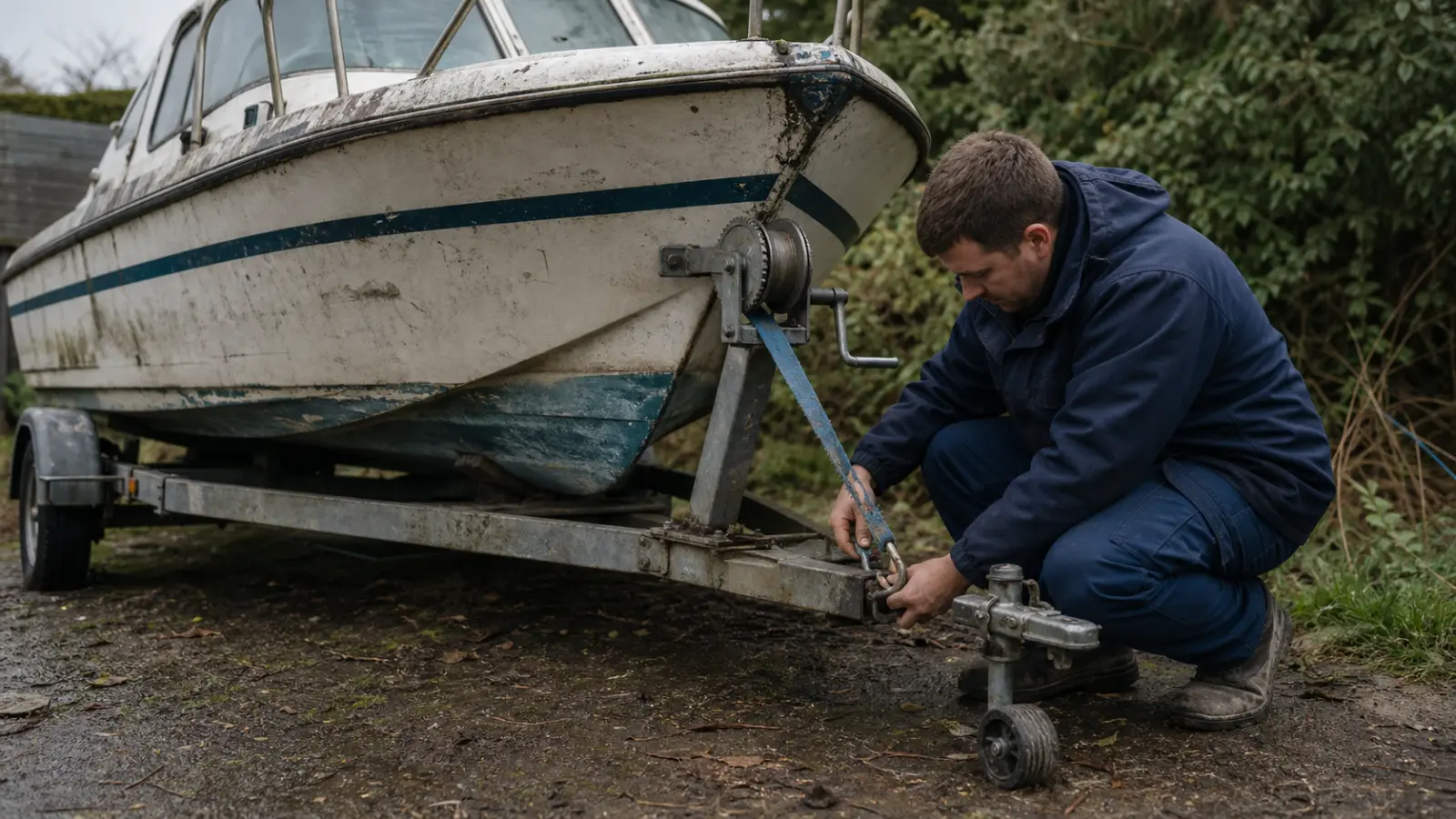
Professional Boat Removal Services in Wyandotte, MI

A fiberglass hull sits behind the garage, its trailer tires flattened into the dirt after six seasons of winter rain and summer heat. Down at a local slip, a marina manager sends a final notice regarding unpaid dockage on an old boat with a seized stern drive. A newly purchased residential property still holds a cabin cruiser left by the previous owner, or an outboard motor burns out when a full engine rebuild costs three times what the vessel is worth. These situations leave property owners stuck with heavy fiberglass, rotted transoms, and rigid state registration requirements that do not vanish on their own.

Is there boat removal near me in Wyandotte, MI? Yes, Boat Removal Experts provides complete hauling, site clearance, and structural transport for ruined or unwanted vessels across Wyandotte, MI and nearby communities like Southgate and Lincoln Park.

Our team provides a formal release of liability paperwork for every project we complete. While a title transfer is not always possible when documentation is missing, issuing a release of liability protects you legally. Other hauling operations often drag a vessel away without signing a single document, leaving the registered owner responsible for future municipal citations or illegal dumping fines. Asking for a written release ensures you are clear of the vessel forever.

Moving a vessel is far more difficult than hauling an ordinary vehicle. A trailer frame often snaps from structural rust, a wide beam cannot clear a narrow yard gate, or a deep draft sits on a soft lawn where heavy tow vehicles immediately sink and stall.

Call 734-336-7320 to start.

Send photos through the contact form.

What Is Boat Removal and When You Need It

Professional boat disposal involves far more than hooking a trailer to a hitch and driving down the road. Complete boat removal covers physical extraction from tight backyard quarters, dismantling oversized superstructures, loading unseaworthy hulls, and clearing out associated marine debris. When an owner possesses a clean title and current registration, the administrative steps remain straightforward. However, when paperwork is lost, expired, or tied to a newly acquired parcel of land, specific state procedures determine how the property is cleared. An abandoned boat left on private property or sitting in a neglected marina slip requires clear documentation before transport equipment touches the hull.
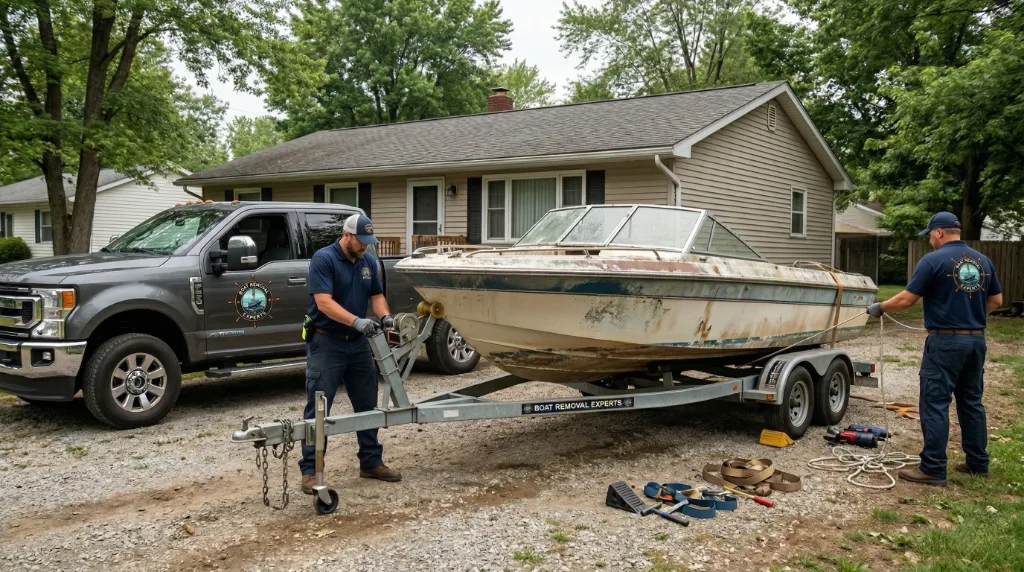
The condition of the title, the physical location of the vessel, and whether the hull can withstand highway speeds dictate the path of disposal. A derelict craft sitting in Ecorse or Riverview with a cracked back panel cannot simply be towed on public roads. When an owner needs to get rid of a boat that lacks structural integrity, specialized rigging equipment must be deployed to lift the weight onto flatbed trailers. Whether handling an abandoned boat removal project from a commercial waterfront or clearing an old runabout from a driveway in Wayne County, physical accessibility and legal ownership status dictate the exact machinery and labor required for safe extraction.
When Wyandotte Residents Call Us

Severe winter freeze cycles and heavy summer humidity accelerate decay on any neglected vessel left outdoors in Wyandotte, MI. Rainwater pools inside open cockpits, freezing during winter months to expand and delaminate internal fiberglass layers. Wood floor frames rot, upholstery gathers toxic mold, and gelcoat develops deep stress cracks that destroy structural integrity. A waterlogged hull becomes significantly heavier than its original factory weight, changing how salvage machinery must balance the load during extraction. A neglected pontoon with flooded aluminum tubes or a heavy sailboat holding saturated deck core material presents unique rigging challenges that standard towing equipment cannot handle.
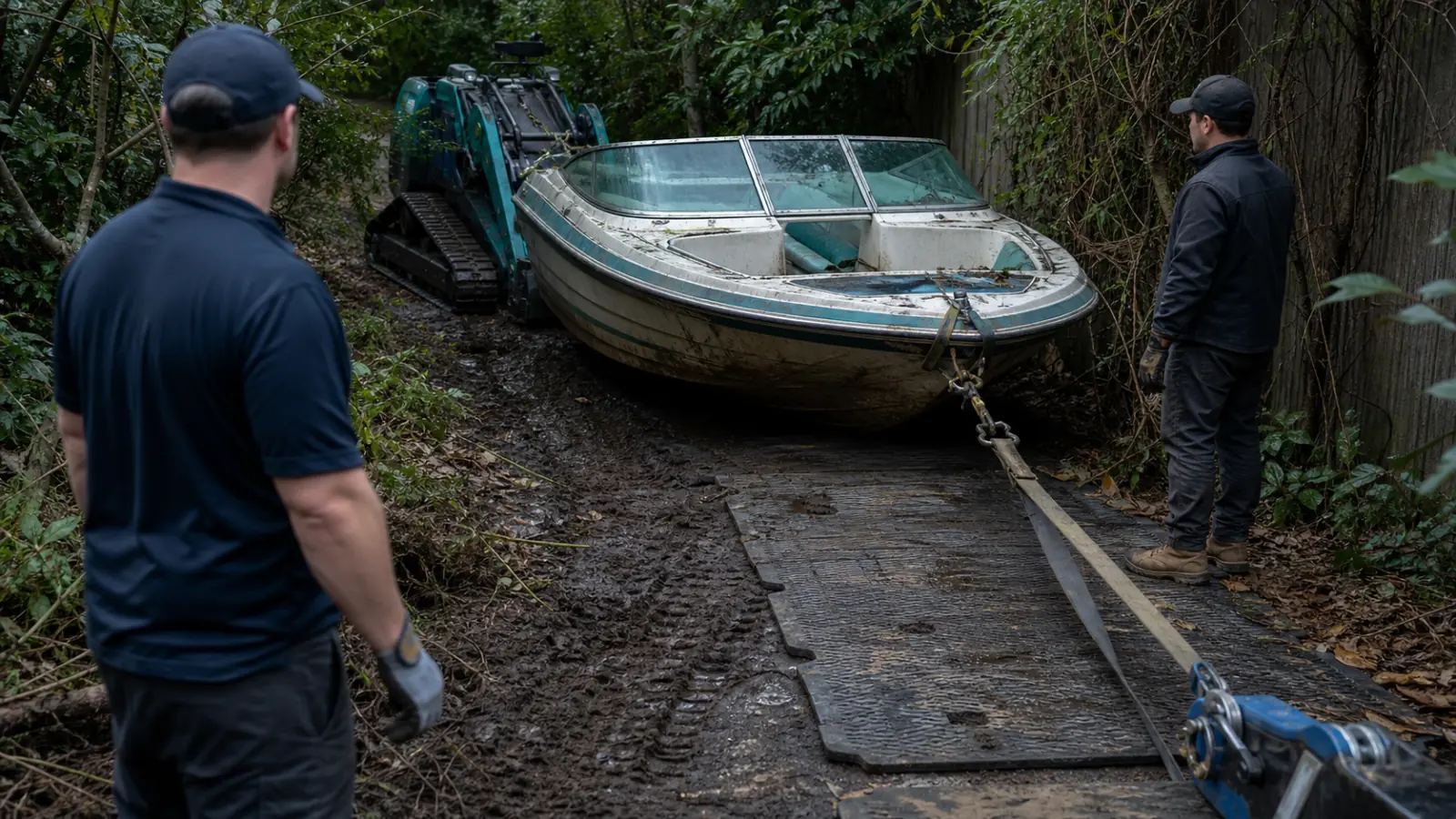
Local property layouts throughout Wyandotte, MI and neighboring Allen Park also dictate how a crew approaches the site. Deep backyards with narrow side alleys, low-hanging tree canopies, and overhead utility lines prevent standard cranes from reaching a hull. Soft grass lawns require protective ground mats so heavy trucks do not rut the soil or sink into underlying mud. Whether a fishing boat sits on sunken wooden blocks, a trailer with frozen axles, or floats in a shallow slip, crew members must evaluate structural access points, overhead clearances, and ground firmness before pulling the vessel from its resting spot.
Every Type of Boat We Handle

Situations We Handle

Need Help? We’re Ready.

Contact boat removers directly or request free quotes. We dispatch crews fast.

Our Step-by-Step Process

Assessment

We evaluate the boat’s size, current location, condition, and any environmental or access challenges before we schedule boat removal.

Planning

A detailed plan is built around your vessel — equipment, logistics, timeline, and safety. Services include drainage of oil and fuel before transport.

Execution

Our experienced crew mobilizes to your current location and we tow, haul, or dismantle the vessel using professional marine equipment.

Completion

The vessel is recovered, recycled, or routed to certified boat junkyards for environmentally responsible disposal. The site is left clean.

Equipment & Capabilities

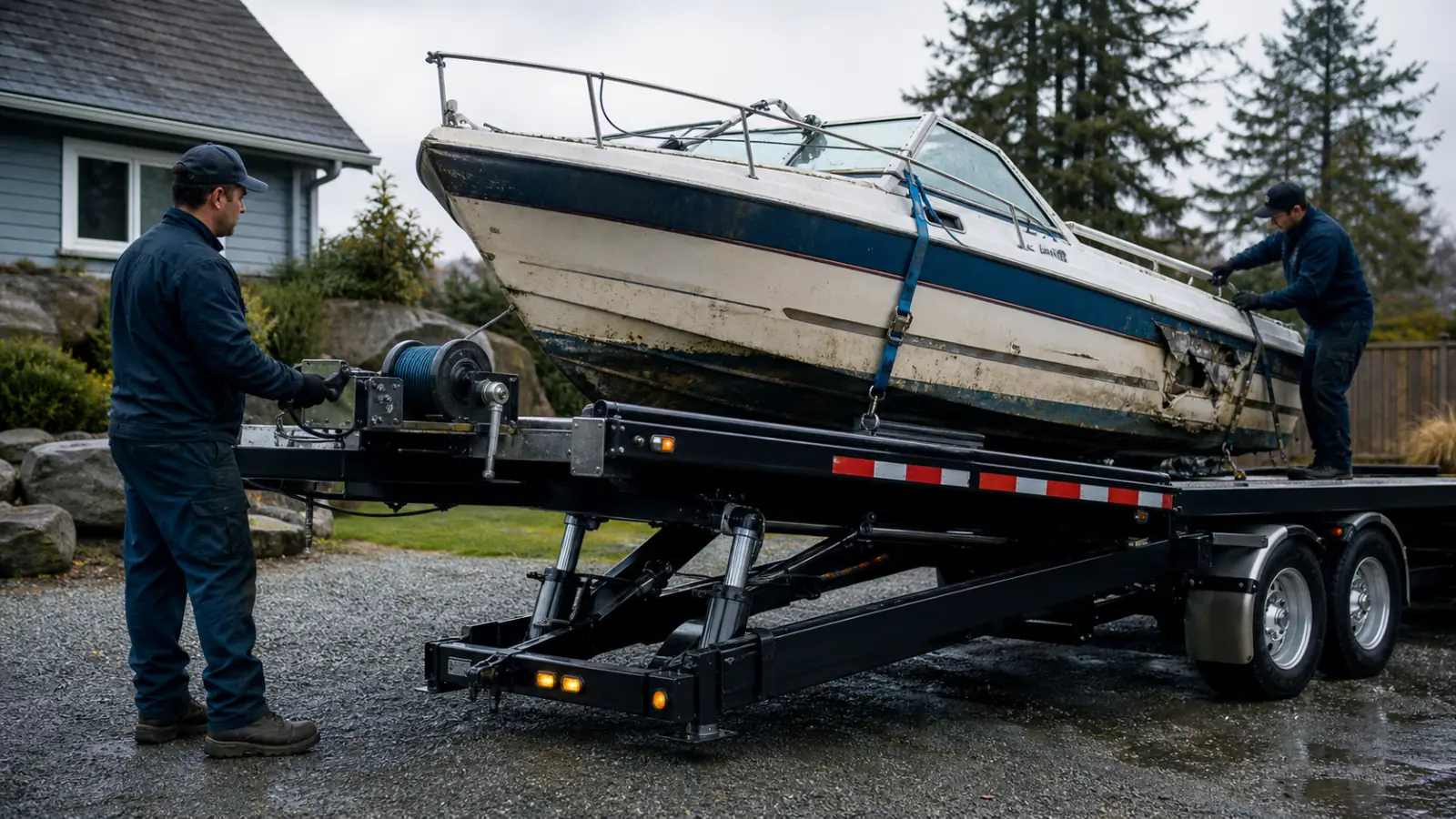
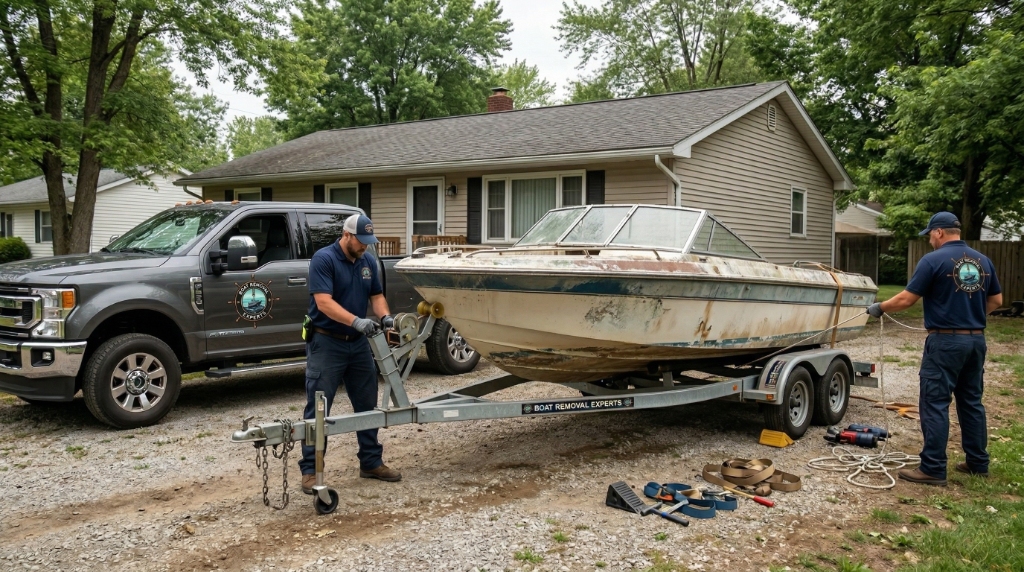
When a trailer is fully rusted through or missing entirely, the extraction crew utilizes heavy hydraulic winches, industrial tilt-deck trailers, and portable gantry cranes to lift and secure the hull. If a vessel exceeds legal transport width or features an elevated cabin that cannot clear low highway overpasses, workers dismantle the deck structures, T-tops, and flybridges right on site using concrete saws and reciprocating cutting tools. Before any hull transport occurs, crew members systematically clear hazardous materials from the vessel. They drain fuel tanks, siphon crankcase oil, unhook marine batteries, and strip out mercury switches, fire extinguishers, and old navigation electronics to prevent environmental contamination.

Where the salvageable metal, fiberglass fragments, and internal components go depends entirely on structural condition and local processing facility rules. Crews sort usable metals like aluminum T-tops, stainless steel hardware, and bronze propellers for targeted recycling. Heavily degraded fiberglass hulls that cannot be salvaged are systematically cut down into manageable sections for safe municipal landfill deposition. Once the crew evaluates the hull condition, physical location, and overall weight distribution, they determine whether to haul the vessel intact or dismantle it directly on the property.

Our boat removal experience covers everything from start to finish  assessment, planning, execution, dismantling, and final cleanup. Marina operators and property owners across Wayne County trust us to get rid of your junk boat without damage to surrounding property.

FAQ

Boat Removal Questions - Frequently Asked

Common questions from property owners about our junk removal service, dismantling, and marine recovery.

We handle every type of vessel — sailboat, pontoon, fishing boats, jon boats, yachts, and commercial craft. Whether your boat or sailboat floats (or used to), we’ll remove it from any current location.

Yes. Sunken and partially submerged vessel recovery is a core part of our salvage work in Wayne County. We use lift bags, salvage pumps, and marine cranes to safely raise vessels from underwater.

We respond to inquiries quickly — usually within hours, with same-day service available. For emergency situations, we mobilize as fast as possible. Call us directly for time-sensitive jobs.

No. Every job is handled in-house by our own team and equipment. No middlemen, no handoffs, no surprises.

Cost depends on the boat’s size, current location, condition, and complexity of the job. We provide free assessments and free quotes for every case — contact us and we’ll give you an honest estimate.

Yes. Our boat removal and disposal services include hazardous materials handling, oil and fuel drainage, hull dismantling, and recycling at certified yards — all in compliance with environmental regulations and environmentally responsible standards.

Absolutely. We regularly work in tight marinas, shallow waterways, private docks, backyards, and remote areas. We bring the right gear to reach any current location.

Yes. We frequently work with insurance adjusters on salvage and recovery claims and provide the documentation needed for your claim.

Browse Our Services - Ready to Get Started?

We handle everything from start to finish. Call us now or request a free quote – we’ll dispatch crews and haul your vessel away fast.