
Professional Boat Removal Services in Norwich, CT

An old boat resting on a flat-tired trailer behind a shed soon becomes a permanent fixture of the property. Years of rain, falling leaves, and freezing weather degrade the hull, while the engine remains locked in place from internal rust. In other cases, a property sale in Norwich, CT leaves the buyer with an unwanted cabin cruiser taking up driveway space, or a marina sends an ultimatum regarding an unpaid slip. When a mechanical rebuild costs vastly more than the market value of the vessel, keeping the craft on the property stops making sense, leaving the owner stuck with a heavy, rotting burden.

Is there boat removal near me in Norwich, CT? Yes, professional haulers clear away unwanted vessels directly from private yards, storage lots, and commercial waterfronts.

When clearing out a junk boat, paperwork matters just as much as heavy equipment. Some unlicensed haulers take a vessel away without documenting the transaction, which leaves the original owner legally responsible if that hull is later abandoned on public land or along a waterway. Our process ensures that a formal release of liability is signed upon pickup, protecting you from future fines even if a formal title transfer is not applicable for your specific vessel.

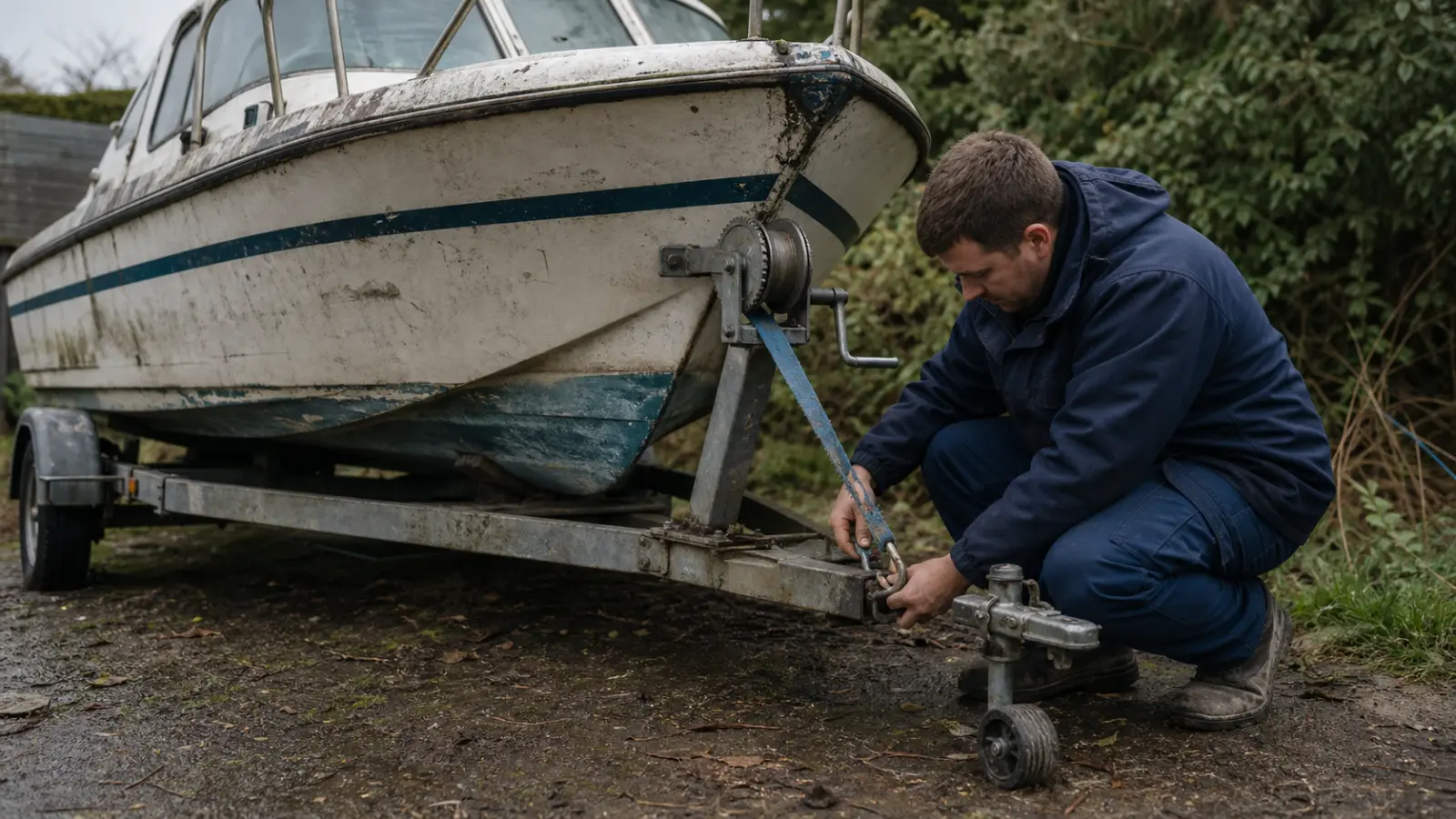
Hauling an old vessel is rarely simple because physical access and structural decay complicate the process. A trailer with dry-rotted tires or rusted axles cannot be towed safely down the road. Keels resting on wooden blocks require specialized hydraulic rigging, while wide beams frequently exceed narrow gate clearances. Furthermore, heavy equipment cannot easily traverse soft lawns without risking severe turf damage.

Call 860-264-0535 to start.

Send photos through the contact form.

What Is Boat Removal and When You Need It

Professional boat disposal involves much more than hooking a winch to a trailer and driving down the road. Complete removal covers structural stabilization, site extraction, loading onto specialized transport, and clearing out hazardous liquids before final processing. An abandoned boat left in a slip or parked in a yard eventually creates code violations, environmental hazards, and legal disputes. Whether you need to get rid of a boat that came with a newly purchased property or clear out a vessel left on commercial land, the approach changes based on ownership records and physical access. When a title is lost or missing, specific paperwork must be generated to legally authorize the haul and shield land managers from liability.
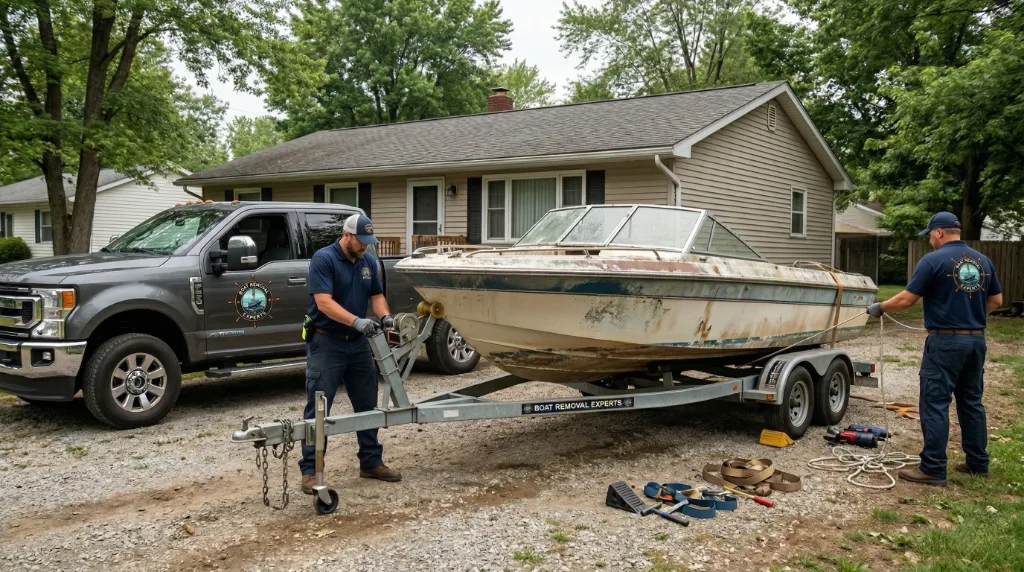
The overall difficulty of an abandoned boat removal project depends heavily on the condition of the vessel and its location. A vessel stored in a neglected slip might require floatation assistance before it can be winched out, while a craft resting on timber cribbing requires crane lifting or hydraulic flatbed loading. If structural rot has compromized the back panel or floor frames, the vessel cannot sustain standard towing stress without snapping. Factors like missing registration numbers, restricted access corridors, and localized environmental conditions determine whether a crew hauls the hull intact or breaks it down directly on the property.
When Norwich Residents Call Us

Vessels left exposed to the elements in New London County suffer rapid degradation due to harsh seasonal weather. Snow accumulation and persistent dampness allow rainwater to pool inside the bilge, expanding during winter freezes and cracking fiberglass hulls. Upholstery holds moisture and sprouts mold, internal wooden bulkheads rot into soft pulp, and outer gelcoat chalks and splits. A neglected sailboat, heavy pontoon, or small fishing boat that has taken on water becomes significantly heavier, complicating the winch load and threatening structural integrity during transport.
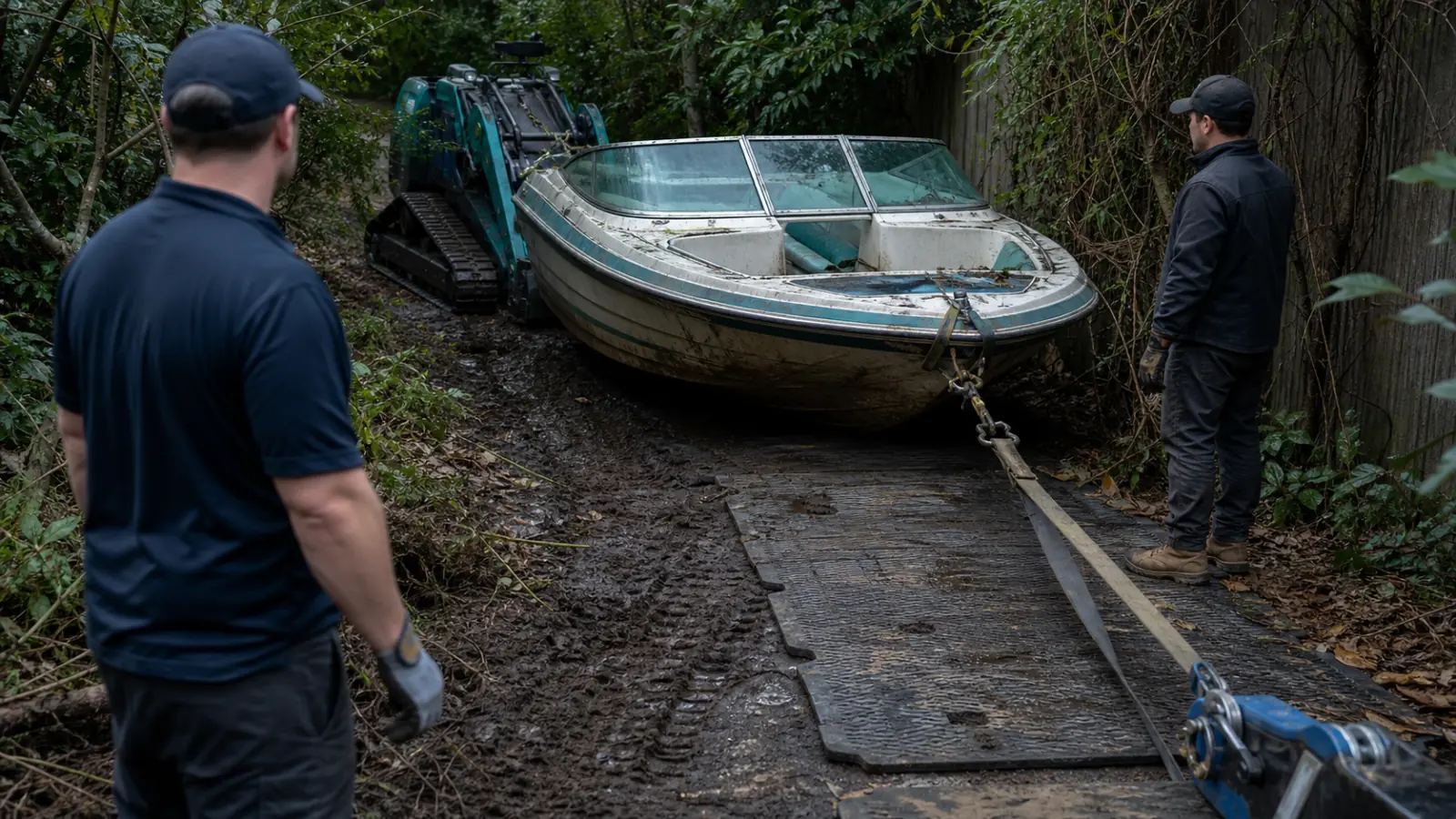
The physical layout of properties in Norwich, CT presents distinct access challenges for heavy hauling machinery. Narrow driveways, low-hanging overhead power lines, and tight property fences limit how close a transport truck can get to the vessel. Soil conditions also dictate the approach, as soft earth or muddy lawns near the Oxoboxo River can trap heavy equipment attempting to reach a vessel stored away from pavement. Crews must evaluate whether the craft sits on a roadworthy trailer, rests flat on rotted blocks, or floats in a marina slip before selecting the proper extraction gear. Additional considerations apply near Mashantucket, Baltic, Jewett City, and Gales Ferry, where steep inclines, tree-lined approaches, and narrow access roads dictate equipment selection.
Every Type of Boat We Handle

Situations We Handle

Need Help? We’re Ready.

Contact boat removers directly or request free quotes. We dispatch crews fast.

Our Step-by-Step Process

Assessment

We evaluate the boat’s size, current location, condition, and any environmental or access challenges before we schedule boat removal.

Planning

A detailed plan is built around your vessel — equipment, logistics, timeline, and safety. Services include drainage of oil and fuel before transport.

Execution

Our experienced crew mobilizes to your current location and we tow, haul, or dismantle the vessel using professional marine equipment.

Completion

The vessel is recovered, recycled, or routed to certified boat junkyards for environmentally responsible disposal. The site is left clean.

Equipment & Capabilities

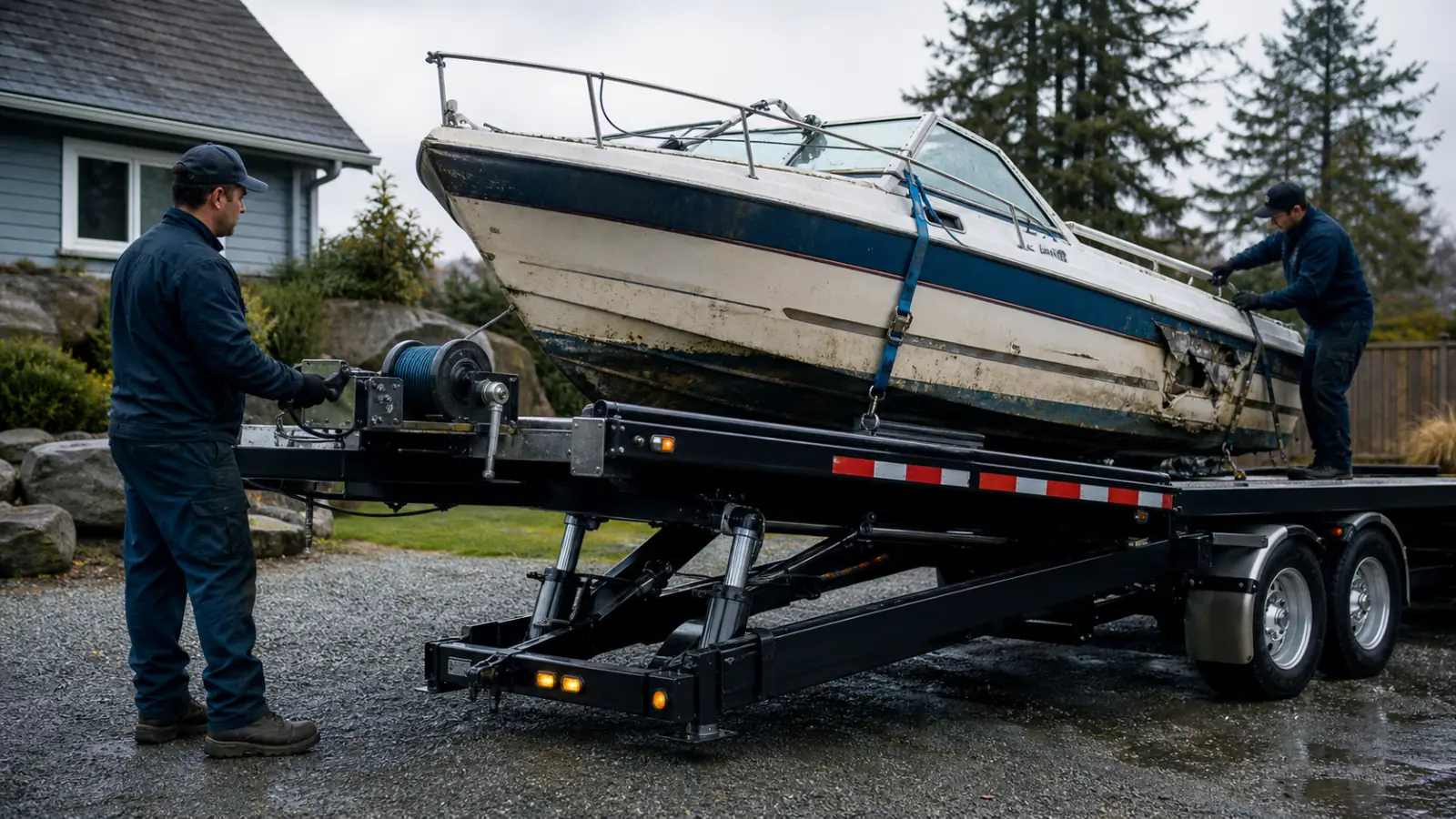
When a trailer is entirely unusable, specialized extraction equipment is brought in to complete the job. Heavy winches, hydraulic slide-axle trailers, and mobile cranes allow crews to move hulls off blocks or out of tight backyard corners. If a vessel is too structurally unstable to haul whole, or if physical boundaries like buildings and trees prevent vehicle entry, crews dismantle the hull directly on site using commercial saws and cutting tools.

Before any hull is loaded or broken down, crew members inspect the vessel for toxic materials. Fluids such as fuel, motor oil, hydraulic lines, and bilge water are carefully drained and contained. Batteries, electronic displays, flares, and mercury switches are removed to prevent environmental contamination during handling. Hazardous materials are sorted out for specialized disposal, while metal hardware, lead ballast, and clean structural elements are routed toward recycling facilities or municipal processing centers based on material composition.

Once on site, the team inspects the hull integrity, evaluates overhead clearances, and checks ground firmness before deciding whether to pull the vessel whole or cut it into sections. The final disposition of the materials rests entirely on what the crew finds during this initial physical assessment.

Our boat removal experience covers everything from start to finish  assessment, planning, execution, dismantling, and final cleanup. Marina operators and property owners across Southeastern Connecticut Planning Region trust us to get rid of your junk boat without damage to surrounding property.

FAQ

Boat Removal Questions - Frequently Asked

Common questions from property owners about our junk removal service, dismantling, and marine recovery.

We handle every type of vessel — sailboat, pontoon, fishing boats, jon boats, yachts, and commercial craft. Whether your boat or sailboat floats (or used to), we’ll remove it from any current location.

Yes. Sunken and partially submerged vessel recovery is a core part of our salvage work in Southeastern Connecticut Planning Region. We use lift bags, salvage pumps, and marine cranes to safely raise vessels from underwater.

We respond to inquiries quickly — usually within hours, with same-day service available. For emergency situations, we mobilize as fast as possible. Call us directly for time-sensitive jobs.

No. Every job is handled in-house by our own team and equipment. No middlemen, no handoffs, no surprises.

Cost depends on the boat’s size, current location, condition, and complexity of the job. We provide free assessments and free quotes for every case — contact us and we’ll give you an honest estimate.

Yes. Our boat removal and disposal services include hazardous materials handling, oil and fuel drainage, hull dismantling, and recycling at certified yards — all in compliance with environmental regulations and environmentally responsible standards.

Absolutely. We regularly work in tight marinas, shallow waterways, private docks, backyards, and remote areas. We bring the right gear to reach any current location.

Yes. We frequently work with insurance adjusters on salvage and recovery claims and provide the documentation needed for your claim.

Browse Our Services - Ready to Get Started?

We handle everything from start to finish. Call us now or request a free quote – we’ll dispatch crews and haul your vessel away fast.